Cost to Hire Employees In Indonesia
The True Cost of Hiring Employees in Indonesia in 2026: A Complete Guide
By the MixWork Team · Last updated 11 September 2026
Key takeaways
• Gross salary is only the first layer: employer BPJS contributions, THR, and recruitment and equipment costs stack on top.
• THR is a mandatory annual bonus of one month of salary for employees with 12 or more months of service, prorated below that.
• PPh 21 income tax is progressive, from 5% to 35%, withheld and remitted monthly by the employer.
• Severance under PP 35/2021 is a real, often-overlooked cost to budget from day one.
• An EOR converts entity setup costs into a predictable monthly fee, from USD 249 per employee per month with MixWork.
| Cost component | Lower salary band | Mid salary band | Higher salary band |
|---|---|---|---|
| Gross monthly salary | IDR 9,000,000 (~USD 580) | IDR 20,000,000 (~USD 1,290) | IDR 35,000,000 (~USD 2,260) |
| BPJS employer contributions | ~USD 62/mo | ~USD 106/mo | ~USD 152/mo |
| THR provision | ~USD 48/mo | ~USD 107/mo | ~USD 188/mo |
| MixWork EOR fee | USD 249/mo | USD 249/mo | USD 249/mo |
| Total monthly cost | ~USD 939 | ~USD 1,752 | ~USD 2,849 |
| Total annual cost | ~USD 11,268 | ~USD 21,024 | ~USD 34,188 |
How statutory costs and the service fee stack on top of three illustrative salary levels in Jakarta. BPJS for the mid and higher bands reflects the pension and health contribution ceilings. Full component-by-component breakdown below.
Statutory employer cost stack, 2026
| Component | Employer | Employee | Base, ceiling and timing |
|---|---|---|---|
| JKK, work accident | 0.24% to 1.74% | None | Gross wage; rate set by the role’s risk class |
| JKM, death benefit | 0.30% | None | Gross wage |
| JHT, old-age savings | 3.70% | 2.00% | Gross wage, no ceiling |
| JP, pension | 2.00% | 1.00% | Capped at IDR 11,086,300 a month from March 2026 |
| BPJS Kesehatan, health | 4.00% | 1.00% | Capped at IDR 12,000,000 a month; covers spouse and up to three children |
| BPJS total | 10.24% to 11.74% | 4.00% | Kesehatan by the 10th, Ketenagakerjaan by the 15th of the following month |
| THR | One month’s wage a year | None | Roughly 8.3% of annual payroll; at least 7 days before the religious holiday |
| PPh 21, income tax | Withhold and file only | 5% to 35% | Deposit by the 15th, file by the 20th of the following month (PMK 81/2024) |
Rule of thumb: gross salary plus 11% for BPJS plus one twelfth for THR is the statutory floor, before the service fee, equipment and any benefits above the floor. Sources: PP 44/2015, PP 45/2015, PP 46/2015, Perpres 82/2018 as amended, PP 36/2021, PMK 81/2024. Figures current as at 11 September 2026.
PPh 21 income tax brackets, 2026
| Annual taxable income (IDR) | Rate | Who it typically catches |
|---|---|---|
| Up to 60,000,000 | 5% | Junior and mid-level professionals after the PTKP allowance |
| 60,000,001 to 250,000,000 | 15% | Most senior specialists and managers |
| 250,000,001 to 500,000,000 | 25% | Senior managers and heads of function |
| 500,000,001 to 5,000,000,000 | 30% | Directors and country leads |
| Above 5,000,000,000 | 35% | Rare in an offshore team |
PPh 21 is the employee’s tax, withheld from gross pay; it changes the net the employee receives, not your cost. The non-taxable allowance (PTKP) is IDR 54 million a year for a single employee plus IDR 4.5 million per dependant, up to three. Monthly withholding uses the TER effective-rate tables (PMK 168/2023) with a December true-up. Employees without a tax number are withheld 20% more. Our PPh 21 employer guide has the worked example.
Recruitment cost, by route
| Route | Typical cost | What you get |
|---|---|---|
| Post it yourself | USD 100 to 400 per posting on Jobstreet, Glints, Kalibrr or LinkedIn | Volume of applicants; your team screens, interviews and verifies |
| Traditional agency | Typically 15% to 25% of first-year salary | A shortlist; employment, onboarding and retention stay with you |
| MixWork talent sourcing | From 10% of first-year salary, paid only when the hire is confirmed | Sourcing, technical and English screening, identity, document and background checks, then compliant employment under the same engagement |
Agency percentages are market ranges we hear quoted, not audited figures; ask any agency for its fee schedule in writing. The MixWork rate is our published rate card.
EOR service fees, by provider type
| Provider type | Published monthly fee per employee | What sits outside the fee |
|---|---|---|
| Global EOR platforms | USD 459 to 599 | Recruitment, workspace, devices, HR supervision and engagement tooling are separately priced modules, often through third parties |
| Low-fee global providers | From USD 199 | Similar scope; check deposit terms and add-on pricing |
| MixWork, Indonesia specialist | From USD 249 | Total Care 360 included; talent sourcing, workspaces and managed devices published separately |
Provider-by-provider figures, each read from the provider’s own pages and dated, are in our best EOR companies in Indonesia comparison. Published rates change without notice; verify before contracting.
Primary sources for the statutory tables above. Law No. 24 of 2011 on BPJS · PP 44/2015, PP 45/2015 and PP 46/2015 (JKK and JKM, JP, JHT) · Presidential Regulation No. 64 of 2020 (BPJS Kesehatan contributions) · BPJS Ketenagakerjaan published contribution rates · Law No. 7 of 2021 on the Harmonisation of Tax Regulations · Government Regulation No. 58 of 2023 and PMK 168/2023 (PPh 21 effective-rate withholding) · PMK 81/2024 (deposit by the 15th, filing by the 20th) · Government Regulation No. 36 of 2021 on Wages as amended by Government Regulation No. 49 of 2025 (2026 minimum-wage formula) · Minister of Manpower Regulation No. 6 of 2016 (THR). Provider fees in the last table are read from each provider’s own published pages and dated where shown. Links open the official text on the government legal databases (JDIH BPK, JDIH Kemenkeu, BPJS Ketenagakerjaan).
Indonesia is one of the most strategically attractive hiring markets in the world. A workforce of over 154 million people, a median age of 31.4, rapidly growing professional talent pools in Jakarta, Surabaya, Bandung and Bali, and salary levels that sit well below equivalent roles in any developed market. For international companies, the opportunity is obvious.
But there is a gap between what an Indonesian employee earns and what it actually costs a foreign company to employ them, and that gap is larger, and more complex, than most first-time hirers expect. Statutory obligations, annual bonuses, social security contributions, recruitment costs, hardware, and (if you are hiring without a local entity), EOR service fees all need to be factored into a realistic budget before you make your first hire.
This guide breaks down every component of the true cost of hiring employees in Indonesia in 2026, from base salary benchmarks by role and city to the full stack of statutory employer contributions, optional benefits, and service fees. By the end, you will have everything you need to build an accurate, defensible hiring budget for your Indonesian team.
Part One: Salary Benchmarks by Role and City
The starting point for any cost calculation is gross salary, what the employee is paid before any deductions or employer contributions are layered on top. Indonesian salaries vary significantly by city, sector, seniority, and employer type (multinational companies typically pay 20 to 30 percent above local market rates for equivalent roles).
Below are approximate monthly salary benchmarks for common professional roles in Indonesia’s major hiring hubs (primarily Jakarta, Bandung, and Surabaya), based on 2026 market data. These figures represent mid-level professionals and are quoted in USD at an approximate exchange rate of IDR 15,500 to USD 1.
What moves salary in Indonesia, and why there are no bands here
Indonesian salaries reprice quickly, and technology, cloud and security roles have been moving fastest. A published band that held in one quarter can be behind the market by the next, so putting role-by-role salary figures on this page would mislead you within months. What does not date is the arithmetic on top of salary, which is what the rest of this page covers: statutory employer contributions, THR, income tax administration and the service fee.
Three things move an individual’s salary more than the job title does: where the experience was earned, meaning a multinational background rather than the same years at a smaller local employer; English strong enough to work with your team without an intermediary; and a track record on large or regulated projects. For a current all-in figure on a specific role and seniority, book a free consultation and we will price it against this week’s market rather than last quarter’s.
City and Regional Variances
Jakarta maintains the highest minimum wage in Indonesia at IDR 5,729,876 per month, followed by Surabaya at IDR 4,494,000 and Bandung at IDR 4,234,010. Market salaries for professional roles track above these floors, but the regional gap is meaningful, a mid-level professional in Surabaya or Bandung will typically earn 15 to 25 percent less than an equivalent hire in Jakarta. For international companies not requiring their team to be in the capital, this creates a genuine cost optimisation opportunity without compromising on talent quality.
In 2026, Indonesia implemented a revised minimum wage formula under Government Regulation Number 49 of 2025, introducing a more localised and productivity-driven approach that integrates regional inflation and economic growth through an adjusted Alpha coefficient, alongside the reintroduction of Sectoral Minimum Wages (UMS) for specific industries. This adds nuance to cost planning for companies with employees across multiple Indonesian cities.
Part Two: Mandatory Statutory Employer Contributions
Gross salary is only the first layer of employer cost. Indonesian law mandates a set of social security and insurance contributions that every employer (including foreign companies hiring through an EOR) must pay on top of the employee’s gross wage. These contributions are non-negotiable, and failure to register or remit them on time carries financial penalties.
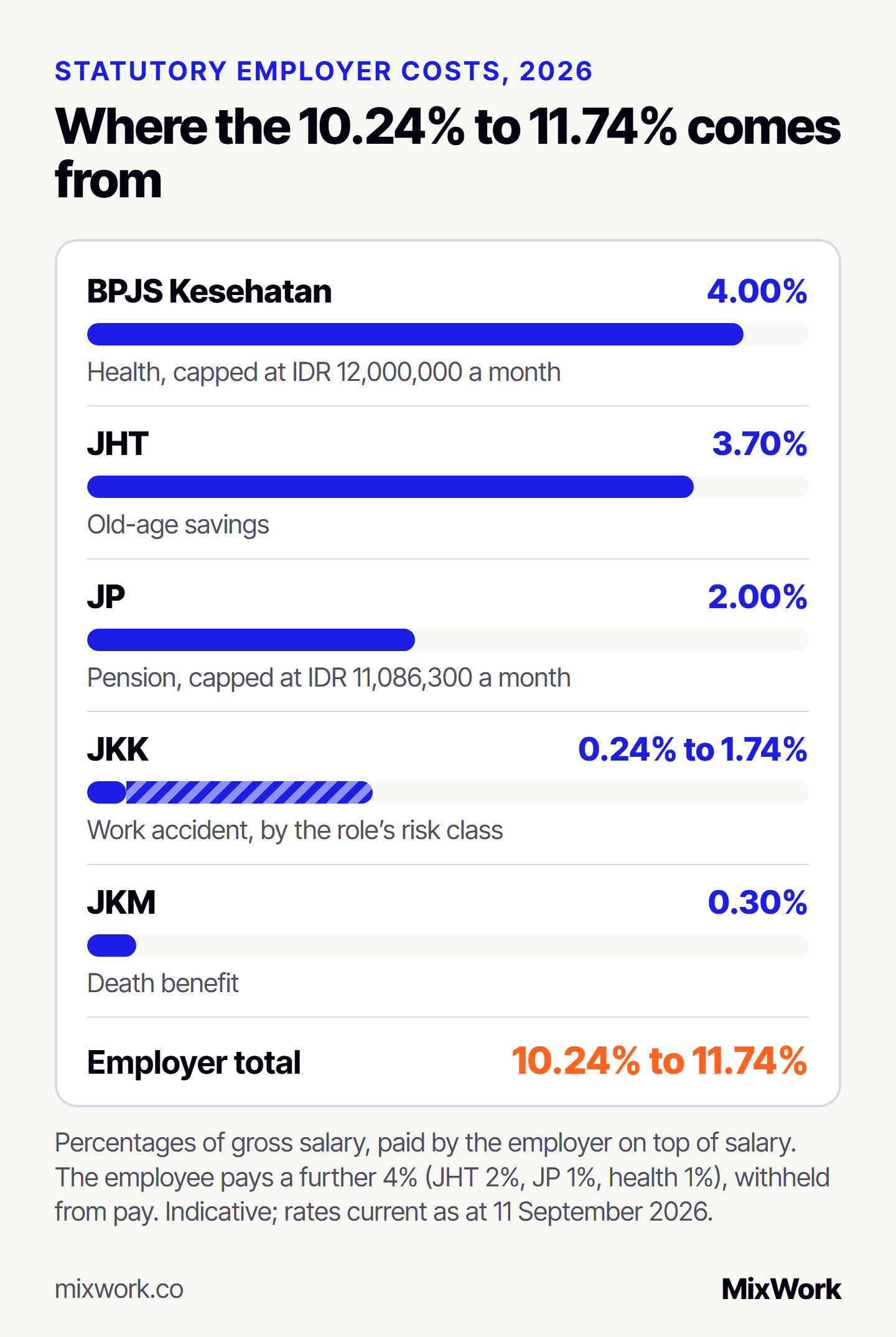
Employer payroll contributions in Indonesia are generally estimated at an additional 10.24% to 11.74% on top of the employee’s gross salary. Here is where that number comes from:
BPJS Ketenagakerjaan (Employment Social Security)
BPJS Ketenagakerjaan is Indonesia’s employment social security program, covering four distinct protections:
Work Accident Insurance (Jaminan Kecelakaan Kerja / JKK): Employer pays 0.24% to 1.74% of gross salary, depending on assessed job risk level
Death Insurance (Jaminan Kematian / JKM): Employer pays 0.30% of gross salary
Old Age Savings (Jaminan Hari Tua / JHT): Employer pays 3.70%, employee pays 2.00%
Pension Insurance (Jaminan Pensiun / JP): Employer pays 2.00%, employee pays 1.00%: capped at a maximum wage of IDR 11,086,300/month
BPJS Kesehatan (National Health Insurance)
Employer contribution: 4.00% of gross salary
Employee contribution: 1.00% of gross salary
Contribution cap: IDR 12,000,000/month gross salary. Even if the employee’s wage exceeds IDR 12,000,000, the maximum employer and employee healthcare contributions are capped at IDR 480,000 and IDR 120,000 respectively.
Coverage: The healthcare program covers a maximum of five family members: the employee, spouse, and three children, including stepchildren.
Summary: Total Employer Contribution Rate
Employer contributions total 10.24% to 11.74% of gross salary once JKK (0.24% to 1.74%), JKM (0.30%), JHT (3.70%), JP (2.00%, capped at IDR 11,086,300 a month from March 2026) and BPJS Kesehatan (4.00%, capped at IDR 12,000,000) are added together. The statutory cost stack table at the top of this guide shows each line with its base, ceiling and payment date.
BPJS Kesehatan contributions are due by the 10th of each month and BPJS Ketenagakerjaan contributions by the 15th of the following month. Late BPJS Ketenagakerjaan payment carries a penalty of 2% for each month of delay. BPJS Kesehatan has no monthly late fine; instead the employer bears a service penalty if the employee needs inpatient care within 45 days of cover being reinstated.
Part Three: Tunjangan Hari Raya (THR): The Annual Religious Holiday Bonus
THR is one of the most frequently misunderstood components of Indonesian employment cost for foreign companies, and one of the most important to budget for correctly.
THR is a mandatory annual bonus paid to employees before their major religious holiday. Employees who have completed 12 months of service receive one full month of gross salary (base salary plus fixed allowances). Employees with less than 12 months of service receive a prorated amount calculated on the basis of months served divided by 12.
Non-compliance with the THR requirement carries a 5% fine on the total unpaid amount, plus potential administrative sanctions. For the majority of Indonesia’s workforce (who are Muslim), THR is paid before Eid al-Fitr. For employees of other religions, it is due before their respective major holiday (Christmas, Nyepi, Waisak, or Natal). If a company prefers to simplify the process, it is legally permissible for all employees to receive THR at the same time if mutually agreed.
In annual budgeting terms, THR adds approximately 8.3% to yearly payroll costs, the equivalent of one additional month of salary spread across the year. For a company with ten Indonesian employees, this is a significant line item that must be planned for in advance.
Part Four: Income Tax (PPh 21)
Indonesia operates a Pay As You Earn tax system, under which individual income tax rates range from 5% to 35% on a progressive rate structure. As the employer, you are responsible for calculating, withholding, and remitting PPh 21 on behalf of your Indonesian employees each month, with payments due by the 15th of the following month, with the monthly return filed by the 20th under PMK 81/2024.
The progressive PPh 21 brackets for 2026 are:
Five brackets, from 5% on the first IDR 60 million of annual taxable income to 35% above IDR 5 billion, applied after the PTKP allowance. The bracket table at the top of this guide shows each band and who it typically catches.
For most mid-level professional hires, the effective income tax rate will fall between 5% and 15%. PPh 21 is a deduction from the employee’s gross pay, not an additional employer cost, but it is the employer’s legal responsibility to calculate and remit it correctly. Errors in PPh 21 calculation expose the employer to back-payment obligations and penalties.
Part Five: The True Total Employment Cost
Pulling the statutory components together, the full employer cost of hiring an Indonesian employee is substantially higher than the gross salary figure alone. For most organisations, total employment cost in Indonesia reaches between 120% and 140% of base salary when all BPJS contributions, THR provisions, and leave entitlements are factored in.
Here is how the numbers look for a practical example:
Example: a mid salary band hire in Jakarta
Gross Monthly Salary: IDR 20,000,000 (~USD 1,290)
BPJS Employer Contributions (~8.25%, after the pension and health ceilings): IDR 1,650,000 (~USD 106)
THR Provision (monthly accrual, 1/12 of monthly salary): IDR 1,667,000 (~USD 107)
Total Monthly Employer Cost: ~IDR 23,317,000 (~USD 1,504)
Annual Employer Cost: ~IDR 279,804,000 (~USD 18,052)
The same arithmetic applies at any salary level: the statutory components scale with the wage, up to the pension and health contribution ceilings, while the service fee does not. Run your own target salary through the cost calculator to see the all-in figure.
Part Six: Recruitment Costs
The cost of finding the right Indonesian employee is a real upfront investment that is often omitted from first-year hiring budgets. There are three main models:
Internal Recruitment: Posting roles directly on Indonesian job boards (Jobstreet, Glints, Kalibrr, LinkedIn) costs between USD 100 and 400 per job post. Sourcing, screening, and interview coordination will consume internal time, at a minimum of 20 to 40 hours of HR and management time for a mid-level hire.
Recruitment Agency (Traditional Retained): Indonesian recruitment agencies typically charge 15% to 25% of the first year’s salary for a placed candidate, often with a partial upfront retainer. For a USD 1,500/month hire, this represents a USD 2,700 to 4,500 fee.
Success-Based Recruitment (MixWork Model): MixWork offers integrated talent sourcing on a success-based model, from 10% of first-year salary, paid only when a hire is confirmed. No retainers. No cost for an unsuccessful search. For a USD 1,500/month hire, the recruitment fee is USD 1,800: significantly below the traditional agency model, with the added benefit that MixWork manages multi-stage candidate vetting, interview coordination, and smooth transition into EOR onboarding.

Part Seven: Hardware and Equipment
For remote-first or hybrid teams, hardware is an additional upfront cost that catches many companies off guard. Shipping a laptop into Jakarta from overseas involves:
Import duties of approximately 10% to 15% on the laptop’s declared value
Freight and logistics costs
Potential customs delays of one to three weeks
Ongoing warranty and repair complications for hardware sourced abroad
Locally procuring a mid-range business laptop (Dell, Lenovo, or MacBook) in Jakarta costs approximately USD 800 to 1,800 depending on spec. MixWork offers hardware procurement and leasing as part of its integrated service: devices are sourced, configured, and delivered directly to employees in Indonesia, removing the logistics complexity entirely.
Part Eight: EOR Service Fees
For companies hiring in Indonesia without a registered Indonesian legal entity (which applies to the majority of international SMEs and growth-stage companies), an Employer of Record acts as the legal employer on your behalf. The EOR is responsible for all employment contracts, BPJS registration, payroll processing, tax remittance, THR calculation, and statutory filings.
EOR service fees vary widely by provider:
Global EOR platforms publish USD 459 to 599 per employee per month for compliance and payroll; low-fee global providers start at USD 199; MixWork starts at USD 249 with Total Care 360 included. The provider-type table at the top of this guide shows what sits outside each fee.
Beyond the fee itself, the scope of what each provider actually delivers varies enormously. Global EOR platforms charge a premium for software functionality and multi-country coverage. MixWork’s pricing includes dedicated account management, integrated HR supervision, optional managed workspace, performance management support, and locally sourced hardware, services that global platforms either do not offer or charge extra for.
For a company with ten Indonesian employees, the difference between MixWork at USD 249 and Deel, G-P or Remote at USD 599 per head per month is USD 3,500 per month (USD 42,000 per year), before accounting for the additional value of MixWork’s integrated services.
Part Nine: Optional Benefits That Drive Competitive Advantage
Beyond statutory minimums, international companies that want to attract and retain the best Indonesian talent typically offer a supplementary benefits package. Many employers offer supplemental benefits such as private health insurance, transportation and meal allowances, flexible working arrangements, and professional development programs to attract and retain talent.
The most effective supplementary benefits in the Indonesian market include:
Private Health Insurance: BPJS Kesehatan provides basic public health coverage, but Indonesian professionals increasingly expect supplementary private health insurance, particularly for inpatient care and specialist access. Employer-paid private health insurance premiums typically run IDR 500,000 to 1,500,000 per month per employee (~USD 32 to 97), depending on coverage tier.
Transport and Meal Allowances: Fixed monthly transport and meal allowances of IDR 500,000 to 1,000,000/month are standard in professional environments and are expected components of a competitive package.
Professional Development: Training budgets, certification support, and English language courses are high-value, relatively low-cost retention tools in Indonesia’s professional market.
Performance Bonuses: Many international companies operating in Indonesia offer discretionary annual performance bonuses of one to three months’ salary, above and beyond the mandatory THR payment.
Professional Office Environment: For employees placed in MixWork’s managed Jakarta workspace, the professional office environment itself functions as a benefit: providing high-speed connectivity, career-signalling professional address, and a community of peers that home-based workers do not have access to.
Employers are increasingly shifting from degree-based to skills-based hiring in Indonesia, with certifications in cloud computing, cybersecurity, project management, financial analysis, and sustainability reporting functioning as measurable competitive differentiators. Companies that invest in developing these skills in their Indonesian team gain both a more capable workforce and a stronger retention proposition.
Part Ten: Severance and Termination Costs
Severance obligations are an often-overlooked component of the true cost of employment in Indonesia, and getting them wrong is expensive.
Under Indonesia’s Manpower Law (Law No. 13/2003) and its Omnibus Law amendments, permanent employees are entitled to severance pay (uang pesangon) based on their length of service. The calculation combines a base severance multiplier, a long-service award, and compensation for rights (replacement for any un-accrued benefits) at termination.
At two years’ service the pesangon table gives three months’ wage, and a business-reason exit at the 1× multiplier pays all three, plus compensation of rights. At five years it is six months of pesangon plus two months of UPMK before the multiplier is applied. Across the whole framework severance runs from about half a month to roughly 28 months of wage: pesangon of one to nine months by tenure, UPMK of two to ten months from three years’ service, and a 0.5 to 2 times multiplier set by the ground for termination.
EOR providers like MixWork manage termination processes end-to-end, ensuring that all Manpower Law obligations are met and that the company avoids the legal disputes and industrial tribunal costs that can arise from poorly handled separations.
Total Cost of Hiring Summary: Three Scenarios
Here is a consolidated view of total annual employer cost for three common hiring profiles in Jakarta, incorporating all statutory contributions, THR provisions, and MixWork’s EOR service fee:
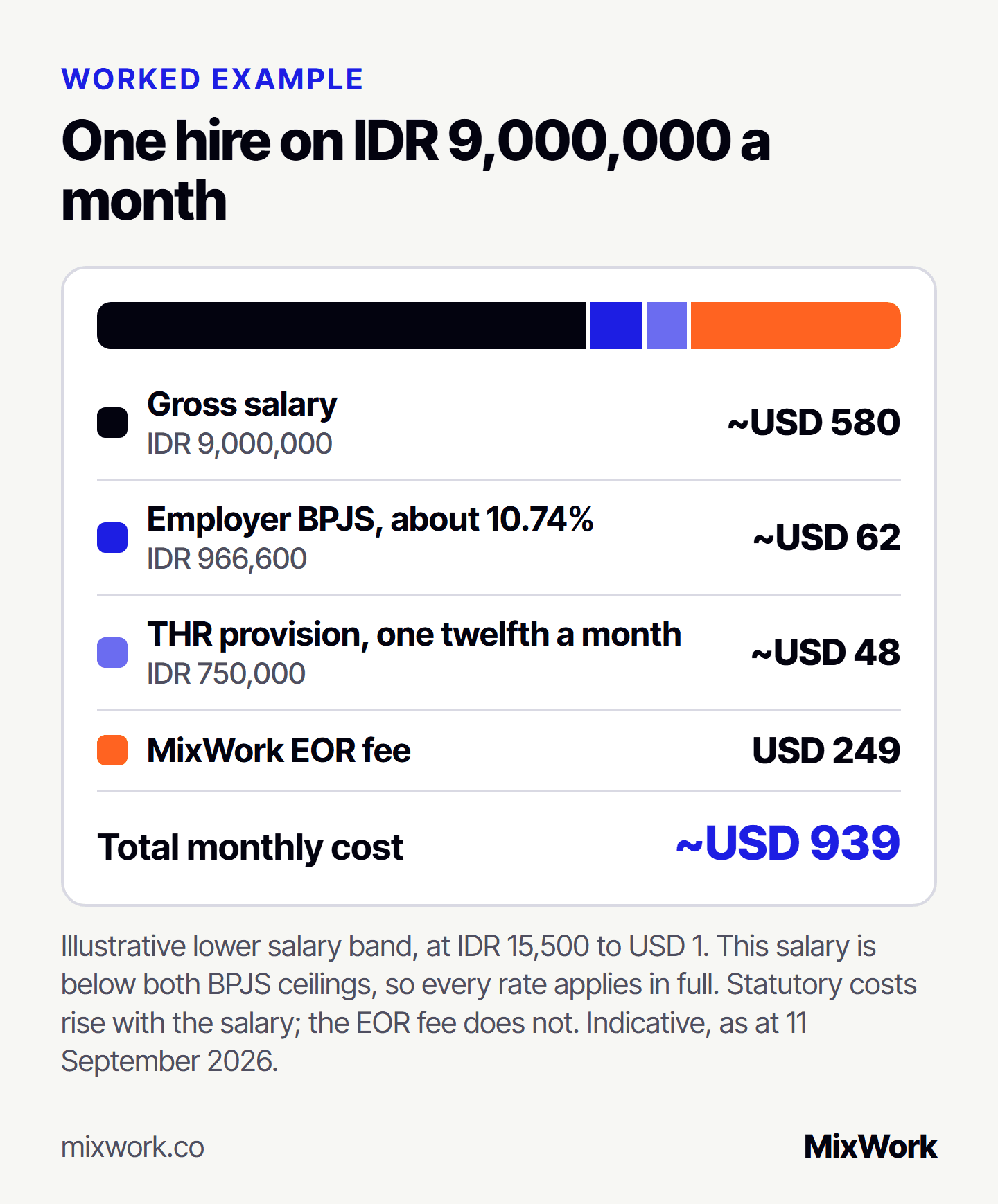
Scenario A: lower salary band
Gross Monthly Salary: IDR 9,000,000 (~USD 580)
BPJS Contributions: ~USD 62/month
THR Provision: ~USD 48/month
MixWork EOR Fee: USD 249/month
Total Monthly Cost: ~USD 939
Total Annual Cost: ~USD 11,268
Scenario B: mid salary band
Gross Monthly Salary: IDR 20,000,000 (~USD 1,290)
BPJS Contributions: ~USD 106/month (after the pension and health ceilings)
THR Provision: ~USD 107/month
MixWork EOR Fee: USD 249/month
Total Monthly Cost: ~USD 1,752
Total Annual Cost: ~USD 21,024
Scenario C: higher salary band
Gross Monthly Salary: IDR 35,000,000 (~USD 2,260)
BPJS Contributions: ~USD 152/month (after the pension and health ceilings)
THR Provision: ~USD 188/month
MixWork EOR Fee: USD 249/month
Total Monthly Cost: ~USD 2,849
Total Annual Cost: ~USD 34,188
These figures represent the total cost of employment through MixWork’s integrated EOR model: inclusive of all statutory obligations, compliance management, dedicated account management, and HR support. They do not include optional supplementary benefits, hardware, or managed office space, which can be added depending on your team’s requirements.
These scenarios use illustrative salary inputs rather than role benchmarks, because Indonesian pay reprices faster than any published band can follow. The value in the table is the structure: what the statutory components and the service fee add on top of whatever the salary turns out to be. For a current figure on a specific role, book a free consultation.
Making Sense of It All: Why the Right Partner Changes Everything
Understanding the full cost of hiring in Indonesia is step one. Executing against it compliantly, efficiently, and in a way that actually produces a high-performing team. That is where most international companies need a partner, not just a payroll tool.
MixWork was built specifically for international companies navigating the Indonesia hiring market, from Singapore, Australia, the UAE, Saudi Arabia, Qatar, and beyond. Their integrated model covers every cost layer outlined in this guide: talent sourcing on a success-based model, EOR and full statutory compliance management, locally procured hardware, professionally managed office space in Jakarta’s Kuningan district, dedicated account management, and an active performance and retention infrastructure that most EOR providers don’t offer at all.
The goal is not just to hire employees in Indonesia compliantly. It is to build exceptional Indonesian teams that stay, perform, and compound in value over time. That is a meaningfully different proposition, and it is what MixWork delivers.
Ready to build your Indonesian team? Contact MixWork to book a free consultation and get a detailed, personalised cost estimate for your specific hiring requirements.
Planning your Indonesia team?
See transparent EOR pricing | Estimate your hiring costs | Book a free consultation
Frequently asked questions
Related guides
• EOR cost in Indonesia: 2026 pricing
• How much BPJS costs employers in Indonesia
• PPh 21 income tax: the employer’s guide
• Employer of Record in Indonesia: complete guide
• Use the hiring cost calculator
• Indonesia EOR pricing index: every published fee, verified monthly
• Indonesia employment law tracker 2026: every change, dated and sourced