
Hire Remote Employees In Indonesia
How to Hire Remote Employees in Indonesia in 2026: The Complete Guide for International Companies
By the MixWork Team · Updated 24 September 2026
Key takeaways
• Foreign companies cannot directly employ Indonesian nationals without a local entity; an EOR is the compliant path to remote hiring.
• Remote employees hold identical statutory rights: written contract, BPJS registration, THR, and PPh 21 withholding.
• Misclassifying remote workers as contractors is the costliest common mistake, triggering reclassification and back-pay liability.
• Indonesia has no dedicated remote-work statute; the Manpower Law applies in full to remote arrangements.
• MixWork manages the full lifecycle: sourcing, contracts, equipment, HR supervision, and retention.
To hire remote employees in Indonesia without a local entity, you engage them through an Employer of Record (EOR): a licensed Indonesian company that holds the employment contract, registers the employee with BPJS Ketenagakerjaan and BPJS Kesehatan, withholds PPh 21 and pays THR, while you direct the work day to day. MixWork’s EOR fee starts at USD 249 per employee per month, and a hire can start as little as two weeks after the brief; the candidate’s notice period is usually what extends it.
Indonesia has become one of the most compelling destinations in the world for international companies building remote teams. A workforce of over 154 million people, a rapidly expanding pool of university-educated professionals, English proficiency levels that now rival other major Southeast Asian hiring markets, and salary benchmarks that are 50 to 70 percent below equivalent roles in a developed market, the case for hiring Indonesian remote employees has never been stronger.
But the path from “we want to hire in Indonesia” to “our Indonesian team is onboarded, compliant, and productive” involves a series of legal, administrative, and operational decisions that most international companies underestimate. Get them right and you gain a real strategic advantage. Get them wrong and you face back-taxes, compliance penalties, or the costs of rehiring after avoidable attrition.
This guide covers everything you need to know about hiring remote employees in Indonesia in 2026, from the legal pathways and employment contract requirements, to BPJS compliance, remote work regulations, talent sourcing, and the full spectrum of factors that determine whether your Indonesian remote team succeeds long-term.
Why Companies Are Hiring Remote Employees in Indonesia Right Now
The demand for Indonesian remote talent has accelerated sharply over the past three years, and the reasons go beyond cost. Indonesia’s urban professional workforce (concentrated in Jakarta, Surabaya, Bandung, Yogyakarta, and Bali) has developed genuine depth across the functions that international companies most commonly offshore: technology and software development, finance and accounting, digital marketing, customer operations, legal and compliance support, logistics coordination, and executive assistance.
For companies in Singapore, the attraction is partly about proximity, a single timezone step, cultural familiarity, and a long-established business corridor. For Australian companies, Indonesia’s time zones fall within two to three hours of Perth and Darwin, making real-time collaboration not just practical but natural.
For businesses in the UAE, Saudi Arabia, Qatar, and the broader Gulf, Western Indonesian Standard Time (WIB, UTC+7) aligns closely with Gulf business hours, enabling the kind of operational overlap that makes a remote team function as an extension of headquarters rather than a distant satellite.
The talent pool itself spans virtually every professional function:
Technology: software engineers, full-stack developers, mobile developers, QA engineers, data analysts, product managers, UX/UI designers, and cybersecurity professionals
Finance and Operations: accountants, financial analysts, operations managers, procurement specialists, and logistics coordinators
Marketing and Content: digital marketers, SEO specialists, content strategists, social media managers, graphic designers, and video editors
Customer and Admin: customer success representatives, virtual assistants, executive assistants, and business process operators
Legal and Compliance: legal researchers, compliance officers, contract administrators, and regulatory affairs specialists
The cost comparison is stark, and it is the reason most companies start looking. A mid-level professional in Jakarta costs a fraction of the same profile in a developed market, and because the difference applies to every hire rather than one, the saving compounds as the team grows. Indonesian salaries reprice quickly, so rather than publishing bands that date within a quarter we give you a current all-in figure for the specific role and seniority you need.
The Legal Landscape: How Foreign Companies Can Hire in Indonesia
Before placing a single job advertisement, international companies need to understand the legal framework that governs hiring Indonesian employees from abroad. There are two pathways, and only one of them is practical for most organisations at the early stages of Indonesian market entry.
Pathway One: Establish a Local Legal Entity (PT PMA)
A PT PMA (Perseroan Terbatas Penanaman Modal Asing) is a foreign-owned limited liability company registered in Indonesia. It gives you full operational presence, the ability to sign contracts, generate local revenue, and hire Indonesian employees directly under your own legal entity. For companies committed to a long-term, significant operational footprint in Indonesia, this is the eventual destination.
The challenge is the journey to get there. Setting up a business in Indonesia typically takes several months and involves a significant investment, with a minimum paid-up capital requirement of IDR 2,500,000,000 (approximately USD 150,000). This capital requirement applies to most foreign-owned companies, though certain sectors and investment incentive programmes may offer different thresholds. Beyond capital requirements, the process involves registering with the Investment Coordinating Board (BKPM), notarising a deed of establishment, obtaining a business identification number (NIB), registering for tax, and opening a local corporate bank account.
For a company that wants to hire its first two or three Indonesian professionals, this process is neither quick enough nor proportionate to the business need.
Pathway Two: Employer of Record (EOR)
Employer of Record (EOR) services provide a practical solution for companies that are not yet ready to establish their permanent presence in Indonesia but need local employees. The EOR already holds a registered Indonesian entity, so there is no registration process on your side: the contract, BPJS registration and payroll setup can be completed in as little as 24 hours once you have chosen your hire.
The EOR manages payroll, benefits and compliance with local regulations and labour laws, sharing all hiring-related risks and obligations without requiring the client company to establish a separate local entity. The EOR becomes the legal employer on paper, while the client company maintains day-to-day management and direction of employees’ work.
This is the route that the vast majority of international SMEs, growth-stage businesses, and even large enterprises take when building their first Indonesian remote teams. An EOR like MixWork absorbs the legal employer obligations (employment contracts, BPJS registration, payroll processing, tax remittance, THR calculations, and all statutory filings), while you retain full control over the employee’s work, output, and integration with your team.
The practical result: you can have a fully compliant Indonesian remote employee operational within days, not months.
Employment Contracts: What Indonesian Law Requires
Whether you hire directly through an entity or through an EOR, every Indonesian employee must have a written employment contract. Employment contracts must be in writing and clearly state the status (fixed-term or permanent), wages, job duties, probation periods, and notice terms.
Indonesian law recognises two contract types:
PKWTT: Indefinite-Term Employment Contract (Permanent)
A PKWTT is a permanent employment contract with no fixed end date. It is the appropriate contract for ongoing roles where the work is continuous and not project-limited. Permanent employees in Indonesia have stronger protections under the Manpower Law (particularly around termination), and are entitled to the full range of statutory benefits including THR, BPJS coverage, and severance entitlements that accumulate over years of service.
For international companies building long-term remote teams, PKWTT contracts are typically the right structure. They signal commitment to the employee, which translates into better retention, and they align with how Indonesian talent expects to be engaged for professional, ongoing roles.
PKWT: Fixed-Term Employment Contract (Contract)
A PKWT is a time-limited contract, appropriate for project-based, seasonal, or genuinely temporary work. Employment contracts come in two forms: definite-term contracts (maximum five years) for project-based work and indefinite-term contracts for permanent roles. PKWT contracts cannot be used for core, ongoing business functions, misclassifying a permanent role as a fixed-term contract is one of the most common compliance errors made by foreign companies in Indonesia, and it carries significant legal and financial consequences.
The Language Requirement
All employment contracts in Indonesia must be written in Bahasa Indonesia. If a dual-language contract is used (which is standard practice for employees working with international companies), the Bahasa Indonesia version is the legally binding one in any dispute. All monetary values within the contract must be stated in Indonesian Rupiah (IDR). EOR providers like MixWork draft, issue, and manage all employment contracts in full compliance with these requirements.
Remote Work Regulations in Indonesia: What Employers Need to Know
Indonesia does not yet have a single, dedicated statute governing remote work arrangements, but the existing legal framework under the Manpower Law fully applies to remote employees, and there are specific compliance considerations that employers should understand.
While Indonesian law does not provide a formal definition, remote work arrangements typically involve work performed outside the employer’s physical premises, using information and communication technology to perform work duties, with continued employment relationship governed by labor law regardless of work location, and compensation continuing according to the employment agreement.
In practical terms, this means:
Remote employees have identical statutory rights to on-site employees. Indonesian employees are granted a minimum of 12 days of paid annual leave in addition to public holidays. For remote workers, these leave provisions remain intact, meaning they are entitled to take time off just as their office-based counterparts would.
BPJS contributions are mandatory regardless of work location. BPJS Ketenagakerjaan (employment social security) and BPJS Kesehatan (health insurance) enrollment must be completed within 30 days of hire, with employer contributions of 10.24% to 11.74% of salary. Remote working does not exempt employers from any of these obligations.
Working hours remain regulated. Standard working hours under Indonesian law are capped at 40 hours per week across five or six working days. Remote arrangements cannot be used to circumvent these limits or require excessive availability outside contracted hours.
Remote work terms should be documented in the employment contract. For positions not covered by collective agreements, remote work terms are established in individual employment contracts. Specifying the employee’s work location, equipment arrangements, and availability expectations in writing protects both the employer and the employee.
There is no statutory reimbursement requirement for home office costs. Indonesian labor law does not explicitly require employers to reimburse internet, telephone, or electricity costs for remote work. However, many professional employers provide monthly allowances for connectivity and workspace costs as part of a competitive benefits package, and this is increasingly expected by professional-grade candidates.

BPJS Compliance for Remote Employees
BPJS compliance is non-negotiable for every Indonesian employee (on-site or remote), and it is one of the areas where foreign companies most commonly make expensive errors when attempting to hire directly without local support.
There are two distinct BPJS programs:
BPJS Ketenagakerjaan covers four employment-related protections: work accident insurance (JKK), death insurance (JKM), old-age savings (JHT), and pension insurance (JP). Total employer contributions across these four programs range from approximately 6.24% to 7.74% of gross salary.
BPJS Kesehatan is the national health insurance program. Employers contribute 4% of gross salary, with a monthly cap applied once the employee’s salary exceeds IDR 12,000,000. The employee contributes 1%. Coverage extends to the employee, their spouse, and up to three children.
BPJS Kesehatan contributions are due by the 10th of each month and BPJS Ketenagakerjaan contributions by the 15th of the following month. Late BPJS Ketenagakerjaan payment carries a 2% penalty for each month of delay. For a company running payroll for ten Indonesian remote employees without a local entity, managing BPJS registration and monthly remittance in compliance with Indonesian government systems is a substantial administrative burden. It is one of the primary reasons international companies use an EOR, the compliance infrastructure is already in place, and the liability risk sits with the EOR rather than the foreign company.
THR: The Annual Bonus You Cannot Forget to Budget For
Employers account for the 13th-month bonus (Tunjangan Hari Raya), a legally required annual payment made before employees’ major religious holidays.
THR is equivalent to one full month of gross salary for employees with 12 or more months of service, and is prorated for employees with less than one year of tenure. It must be paid at least seven days before the employee’s major religious holiday: Eid al-Fitr for Muslim employees, Christmas for Christian employees, and the relevant holidays for employees of other faiths.
Non-compliance with THR carries a 5% fine on the total unpaid amount, plus potential administrative sanctions from the Ministry of Manpower. For companies running payroll independently without local expertise, calculating THR correctly (particularly across employees with different religions, different tenure lengths, and different fixed allowance structures) is genuinely complex. EOR providers calculate and disburse THR automatically, ensuring compliance without requiring the foreign company to track the Indonesian religious calendar or individual employee tenure calculations.
Misclassification: The Risk That Catches Companies Off Guard
One of the most common (and most costly), mistakes international companies make when hiring Indonesian remote workers is treating them as independent contractors rather than employees.
Misclassification risks while hiring abroad can lead to hefty fines, penalties, and legal issues, including statutory benefits and back pay to the misclassified worker. From a tax perspective, penalties can be levied for failure to submit relevant tax returns, with tax crime penalties reaching up to 400% of unpaid taxes, plus possible imprisonment of up to six years.
Under Indonesian law, the distinction between an employee and an independent contractor is determined by the substance of the working relationship, not what the contract says. If a person works fixed hours, follows your company’s direction, uses your tools, and has no other clients, they are almost certainly an employee under Indonesian law, regardless of whether you have labelled them a contractor.
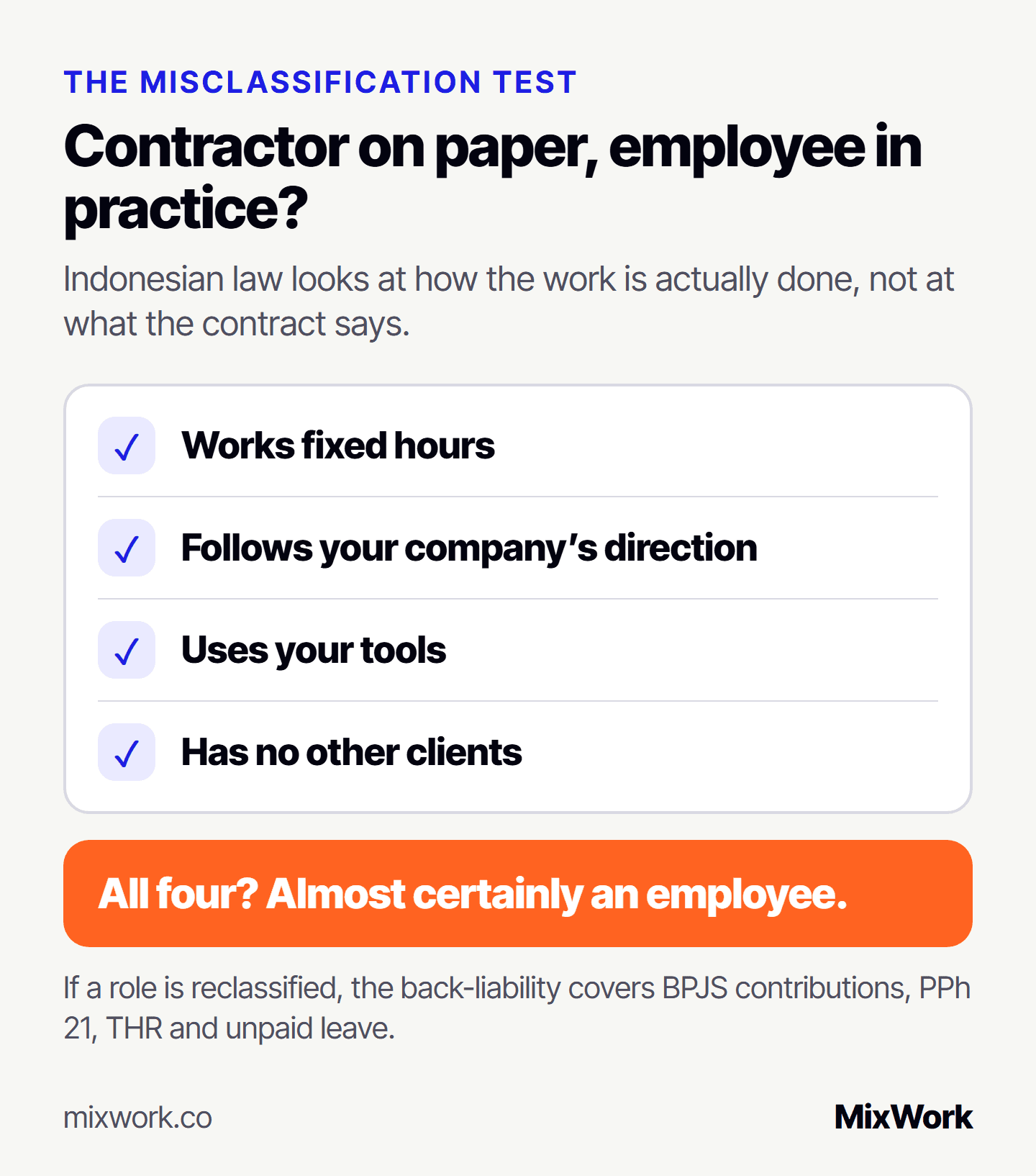
If an audit or complaint triggers an investigation and misclassification is found, the back-liability for BPJS contributions, PPh 21 taxes, THR, and unpaid leave entitlements can be substantial.
An EOR structure eliminates this risk by ensuring every Indonesian remote worker is engaged as a compliant employee from day one.
How to Source the Right Indonesian Remote Talent
Finding qualified Indonesian remote employees requires a different approach than posting a job on LinkedIn and waiting. Indonesia’s professional talent market has its own platforms, networks, and hiring norms, and understanding them is the difference between a fast, high-quality hire and months of unsuccessful recruitment.
Leading Indonesian Job Platforms
Jobstreet Indonesia: The dominant general job board for professional roles, used by both job seekers and employers across all industries
Glints: Particularly strong for technology, startup, and remote-first roles; well-suited for international employers
Kalibrr: Focused on professional and managerial profiles, with assessment tools built into the platform
LinkedIn: Growing rapidly in Indonesia’s professional market; essential for senior and specialist roles
KitaLulus: Popular among younger professionals and recent graduates across technology and business functions
What Makes Hiring in Indonesia Different
Local job boards and social media channels are widely used, but word-of-mouth and trusted networks matter just as much. Partnering with university alumni groups, professional associations, and employee referrals often delivers more value than generic “spray and pray” recruitment. Many Indonesian professionals prefer working with international employers that invest in personal growth and respectful management.
For international companies without existing networks in Indonesia’s talent market, building sourcing capability from scratch is time-consuming and often produces lower-quality shortlists than a partner with deep local presence. MixWork’s integrated talent sourcing service manages the full recruitment process (wide-net sourcing across all major platforms, multi-stage candidate vetting, interview coordination, and shortlisting), on a success-based model that costs from 10% of first-year salary and is only payable when a hire is confirmed.
The Vetting Process That Matters
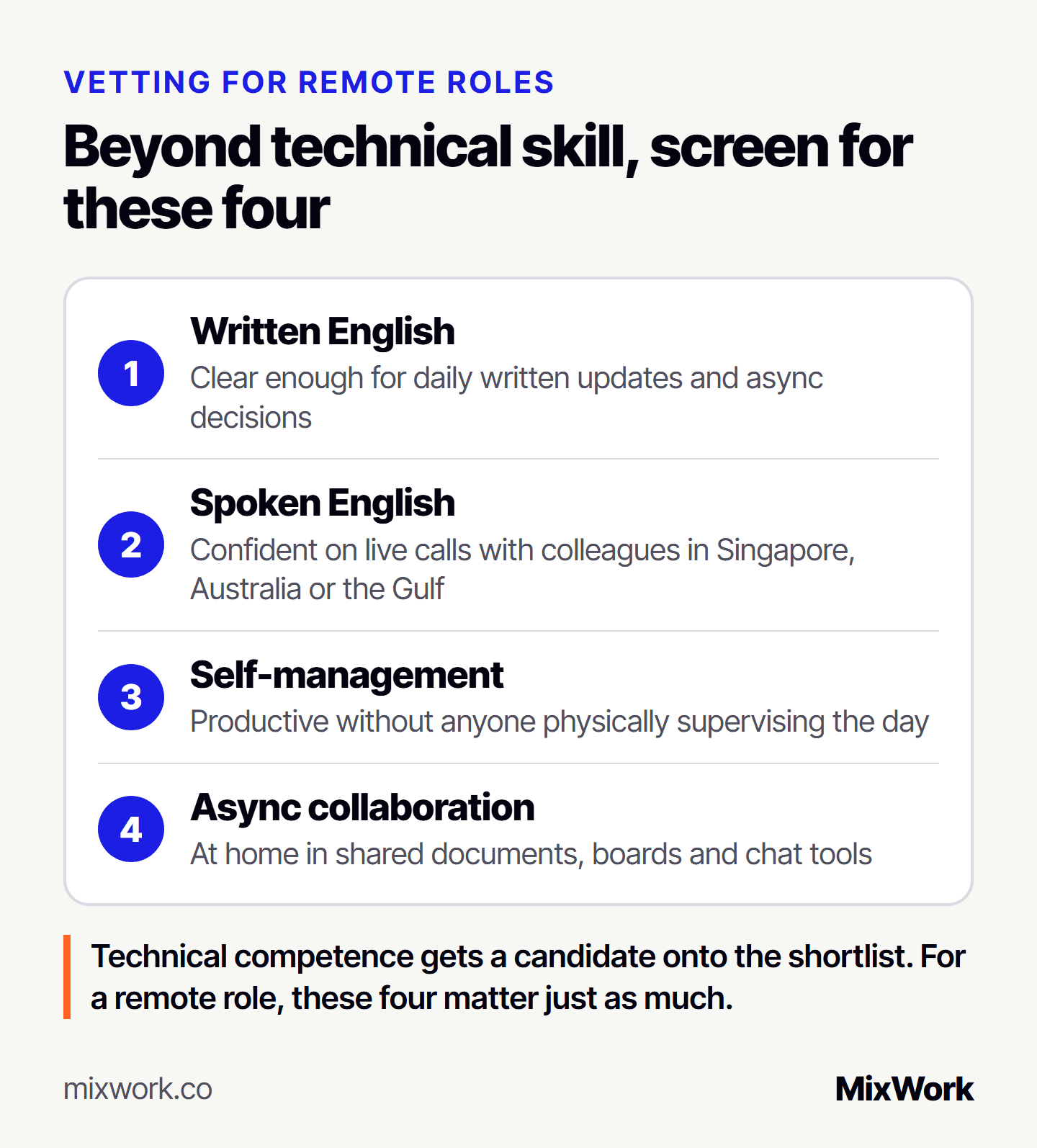
For remote roles specifically, the screening criteria that matter most extend beyond technical competence. Communication skills (both written and verbal in English) are critical for roles that require daily interaction with Singapore, Australian, or Gulf-based colleagues. Self-management discipline, the ability to work productively without physical supervision, and comfort with asynchronous collaboration tools are equally important differentiators. MixWork’s vetting process assesses all of these dimensions before presenting candidates to clients.
Setting Your Indonesian Remote Team Up for Success
Hiring compliantly is a prerequisite. Building a genuinely high-performing Indonesian remote team requires going further, and this is where the model you choose to support your team makes the biggest practical difference.
The Managed Workspace Advantage
Many international companies default to fully home-based arrangements for their Indonesian remote teams, attracted by the simplicity of a remote-only model. For some roles and some employees, this works well. For others (particularly those in data-sensitive industries, or those whose home environments are not conducive to focused professional work), it creates both productivity and security risks.
MixWork offers a differentiated solution that no major global EOR platform provides: professionally managed, dedicated office space in Jakarta’s Kuningan district. For companies in financial services, logistics, legal operations, or any industry with data governance requirements, placing your Indonesian remote team in a secure, enterprise-grade office environment (with reliable high-speed internet, power backup, and IT support) is not a luxury. It is a risk management decision.
At approximately USD 199 per desk per month, MixWork’s managed workspace delivers professional infrastructure at a fraction of what a conventional office lease in Jakarta’s commercial district would cost, and with none of the legal and administrative complexity that direct office leasing involves.
Hardware and IT Logistics
Clear contracts that define remote expectations, working hours, and deliverables, as well as maps of digital security, are especially important for regulated sectors like finance, health, and IT/cybersecurity.
Getting the right hardware to Indonesian remote employees is a logistical challenge that most international companies do not anticipate until they are in the middle of it. Shipping laptops into Indonesia from overseas involves import duties of 10 to 15%, freight delays, and complex warranty arrangements. MixWork procures, configures, and delivers hardware locally (MacBooks, Dell laptops, and associated peripherals), directly to your employees in Jakarta, removing the logistics burden entirely.
Performance Management and HR Supervision
Remote team management across a significant timezone and cultural distance requires more than good intentions. MixWork’s integrated HR supervision layer provides on-the-ground people management support, a local presence that monitors the health of your team’s working experience, supports structured performance feedback, and flags engagement issues before they become attrition events.
For a managing director in Singapore or a CEO in Dubai overseeing an Indonesian remote team, having a local HR partner actively managing the employee experience is the practical difference between a team that compounds in quality over time and one that turns over at the 12-month mark.
Benefits That Drive Long-Term Retention
Indonesian remote professionals (particularly the senior, high-value profiles that international companies most want to attract), evaluate total compensation packages, not just base salary. Beyond mandatory statutory benefits, the most effective retention investments in Indonesia’s professional market include:
Supplementary private health insurance: BPJS Kesehatan provides basic public coverage, but private health insurance (particularly for specialist and inpatient care) is a meaningful differentiator in compensation negotiations with senior candidates. Monthly premiums of IDR 500,000 to 1,500,000 per employee represent a modest cost relative to the retention value they deliver.
Professional development investment: Certification support, training budgets, and English language programs are highly valued by Indonesian professionals and signal that an employer views them as a long-term asset rather than a cost arbitrage. Employers who invest in personal growth and respectful management are strongly preferred by many Indonesian professionals.
Performance bonuses above THR: A discretionary annual performance bonus (one to three months’ salary, tied to clearly communicated KPIs) is a powerful retention lever that aligns the employee’s financial interests with your company’s success.
A professional working environment: For employees in MixWork-managed workspace, the office itself functions as a daily retention signal, a physical manifestation of the employer’s investment in their working experience that home-based arrangements cannot replicate.
Step-by-Step: How to Hire an Indonesian Remote Employee Through MixWork
Watch how MixWork EOR works in under two minutes
What we handle for you, how quickly setup can happen, and how we look after you and your people.
For international companies ready to move from intention to action, here is what the end-to-end process looks like with MixWork as your integrated workforce partner:
Step 1: Consultation and Role Scoping. A free 15-minute consultation with MixWork’s team establishes your hiring requirements, the strategic context of the role, and the KPIs you need a new hire to own. MixWork helps craft job scopes and requirements that will attract the right candidates in Indonesia’s market.
Step 2: Talent Sourcing. MixWork’s recruitment team conducts wide-net sourcing across Indonesia’s leading job boards and professional networks, running an initial round of tests and interviews before presenting you with a shortlist of three to five qualified candidates. You conduct final interviews and make the selection.
Step 3: Offer and Onboarding. MixWork acts as professional intermediary to manage the offer process, draft a fully compliant Bahasa Indonesia employment contract, and handle all administrative and legal onboarding (BPJS registration, tax enrolment and documentation) in as little as 24 hours once you have chosen your hire. Recruitment typically takes two to three weeks from brief to accepted offer, and when the candidate is available, a hire can start as little as two weeks after the brief; the candidate’s notice period is usually what extends it.
Step 4: Workspace and Hardware Setup (Optional). If your employee will work from MixWork’s managed Jakarta office, their desk is configured and ready. If hardware is needed, local procurement and delivery is arranged.
Step 5: Ongoing Payroll, Compliance, and HR Support. MixWork manages monthly payroll, BPJS contributions, PPh 21 tax withholding, THR calculation, leave management, and performance support on an ongoing basis, with your dedicated account manager available as a consistent, named point of contact.
Choosing the Right EOR Partner for Indonesian Remote Hiring
Not all EOR providers are equal, and for Indonesia specifically, the differences matter significantly.
Global EOR platforms offer broad country coverage and sophisticated software dashboards, but are built for breadth across many countries rather than depth in any one of them. They process payroll and handle basic compliance. They do not source candidates, they do not offer physical office infrastructure, they do not provide local HR supervision, and they charge EOR management fees of USD 599 to 699 per employee per month.
MixWork is purpose-built for the Indonesia market. Their EOR management fee starts from USD 249 per employee per month, a saving of USD 350 to 450 per head per month against global platforms. For a team of ten Indonesian remote employees, that represents savings of USD 42,000 to 54,000 per year on management fees alone, before accounting for the additional services (talent sourcing, managed workspace, hardware, performance management, and dedicated account support), that are either unavailable or charged separately by global platforms.
For companies whose Indonesian remote team is their primary or most strategic offshore hiring market, MixWork’s combination of local expertise, integrated services, competitive pricing, and genuine on-the-ground infrastructure makes them the clear choice.
Primary sources
• Law No. 13 of 2003 on Manpower, as amended by Law No. 6 of 2023 on Job Creation: employment contracts, working time, wages and termination.
• Government Regulation No. 35 of 2021: fixed-term contracts (PKWT), probation, working time and severance.
• Law No. 24 of 2011 on BPJS and the BPJS Ketenagakerjaan contribution rates: registration duty and employer rates.
• PMK 81/2024: PPh 21 withholding, the 15th deposit deadline and the 20th filing deadline.
• Government Regulation No. 49 of 2025, amending Government Regulation No. 36 of 2021 on Wages: minimum wage setting.
• Law No. 27 of 2022 on Personal Data Protection: handling employee data in remote arrangements.
This guide is general information current as at 24 September 2026. It is not legal advice; confirm contract, tax and BPJS questions with qualified Indonesian counsel before you rely on them.
The Bottom Line
Hiring remote employees in Indonesia in 2026 is one of the most powerful workforce decisions an international company can make. The talent is exceptional, the cost advantages are real, the timezone alignment with Singapore, Australia, and the Gulf is highly practical, and the tools now exist to do it compliantly and efficiently without setting up a local entity.
The difference between companies that make this work and companies that struggle comes down to one thing: the quality of the partner they choose to help them do it. Payroll compliance is a prerequisite, not a competitive advantage. What actually builds great Indonesian remote teams (over the long term, with high retention and compounding performance) is the integrated model that MixWork has been designed to deliver.
Ready to hire your first remote employee in Indonesia? Book a free consultation with MixWork and get your team started within weeks.
Planning your Indonesia team?
See transparent EOR pricing | Estimate your hiring costs | Book a free consultation