Employer of Record Indonesia: The Complete 2026 EOR Guide
By the MixWork Team · Updated 17 October 2026
Watch how MixWork EOR works in under two minutes
What we handle for you, how quickly setup can happen, and how we look after you and your people.
Key takeaways
• An Employer of Record (EOR) is a company legally licensed to employ staff in Indonesia on your behalf, while you keep full day-to-day management of their work.
• EOR activation and onboarding in Indonesia can take as little as 24 hours once you have chosen your hire, versus months of setup and substantial capital for a PT PMA. If MixWork also finds the hire, recruitment typically takes two to three weeks to an accepted offer.
• A full-service EOR handles the employment contract, BPJS registration, monthly payroll, income tax and THR, so your hire is compliant from day one.
• Indonesia’s parliament passed a new employment bill in October 2026. It is not in force yet and its details are still to come. With MixWork, keeping your team compliant through the change is part of the service.
• MixWork’s EOR includes Total Care 360, background checks and HR supervision, delivered from our own offices in Singapore and Jakarta. MixWork Recruit can find the hire too, on a success fee.
| Factor | Employer of Record | PT PMA |
|---|---|---|
| Setup time | As little as 24 hours | Several months |
| Capital requirement | None | ~USD 150,000 minimum |
| Revenue generation in Indonesia | No (employment only) | Yes, full commercial operations |
| Compliance management | Fully managed by the EOR | Ongoing in-house or external HR and legal |
| Flexibility to scale or exit | High | Low; entity dissolution is complex |
| Best for | Market testing, remote teams, 1-30 employees | Long-term commitment, 30+ employees, local revenue |
EOR versus PT PMA at a glance.
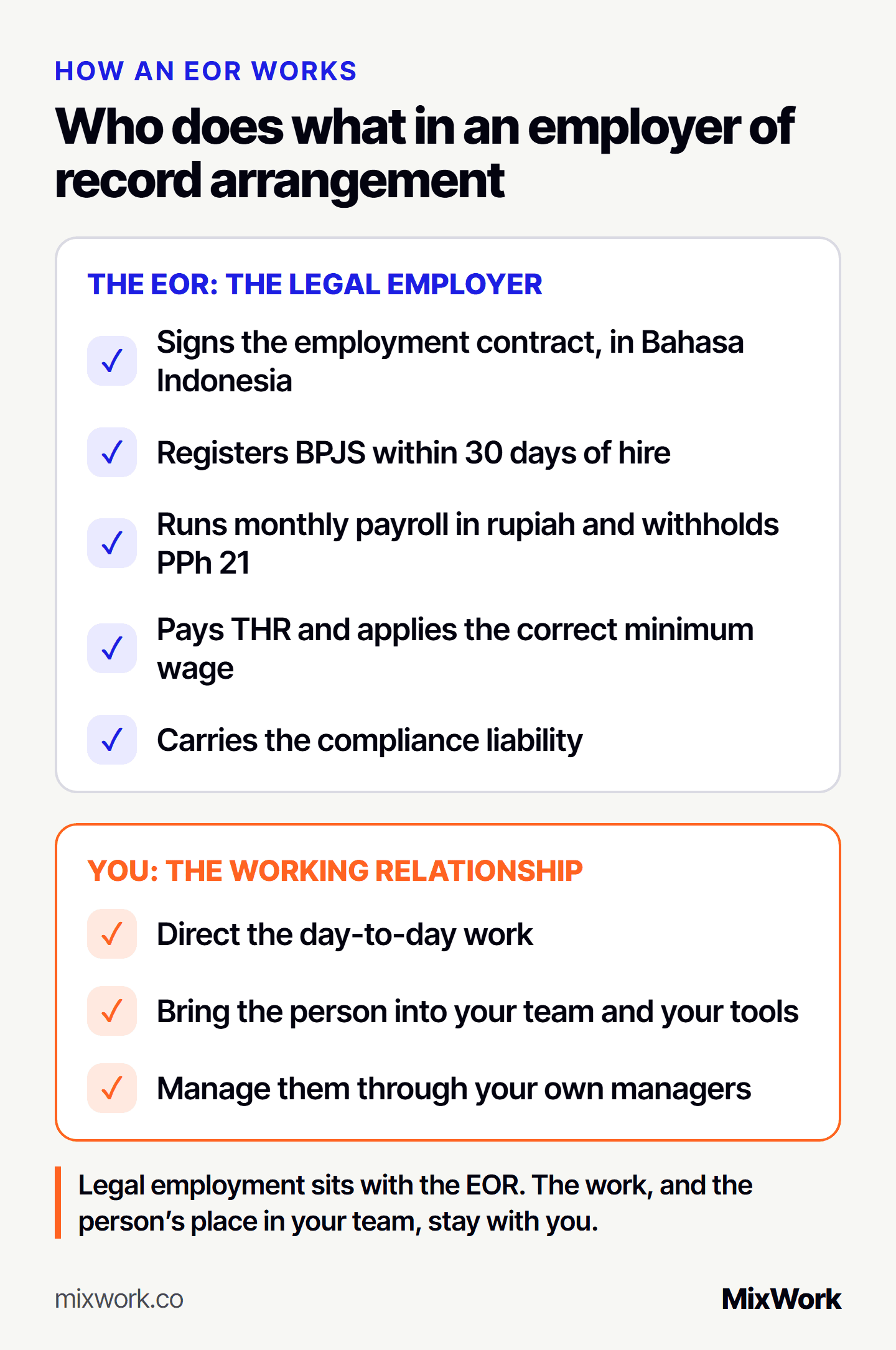
An employer of record (EOR) in Indonesia legally employs your Indonesian staff on your behalf. It signs the Bahasa Indonesia contracts, registers each person with BPJS, runs monthly payroll and PPh 21 withholding, and carries the compliance liability, while you direct the day-to-day work.
Through MixWork, a hire can be activated and onboarded in as little as 24 hours, with no local entity or paid-up capital. This guide covers how the model works, whether it is legal, what it costs in 2026 and how to choose a provider.
What Is an Employer of Record in Indonesia?
An Employer of Record (EOR) is a company legally licensed to employ people in Indonesia, and it becomes the formal, legal employer of your Indonesian staff on your behalf. The EOR signs the employment contracts, registers employees with BPJS social security, processes payroll and tax remittances, manages statutory filings, and assumes full legal responsibility for compliance with Indonesian labour law, while you retain complete day-to-day management and operational direction of your employees’ work.
The model separates two things that are often conflated: legal employment and operational management. The EOR owns the legal employer relationship. You own the working relationship. Your Indonesian employees follow your direction, integrate into your team, use your tools, and report to your managers. They just do so under a contract held by the EOR rather than your foreign company, which, without a registered Indonesian entity, has no legal capacity to directly employ Indonesian nationals.
Is an Employer of Record Legal in Indonesia?
Yes. Employing through an EOR is a recognised arrangement under Indonesia’s Manpower Law. The EOR holds the employment contract and carries the compliance duties, while you direct the day-to-day work.
The EOR is the legal employer responsible for complying with Indonesian labour law. The foreign company directs the work but cannot sign local employment agreements or pay salaries directly in Indonesia.
Indonesia’s New Employment Law
Indonesia’s parliament passed a new employment bill in October 2026. It is not in force yet, and its final text and start date haven’t been published. If you employ through MixWork, bringing contracts and payroll in line with the new law once it takes effect is part of the service. We’ll update this guide when the details are out.
What Does a Full-Service EOR in Indonesia Actually Manage?
Everything that makes someone legally employed and properly looked after: Bahasa Indonesia contracts, BPJS registration, monthly payroll, PPh 21 withholding, THR, the correct regional minimum wage, leave and overtime, background screening, confidentiality and data protection terms, and termination if it ever comes to that.
Employment Contracts
Contracts must be in Indonesian using the Latin alphabet, with the Indonesian version being legally binding. Employment contracts should outline the type of contract (fixed-term or permanent), working hours, remuneration in IDR, job duties, probation terms, and notice requirements.
There are two contract types. A PKWTT (Perjanjian Kerja Waktu Tidak Tertentu) is a permanent contract, the right structure for ongoing professional roles. A PKWT (Perjanjian Kerja Waktu Tertentu) is a fixed-term contract that can only be used for genuinely temporary or project-based work.
Using a fixed-term contract for a core, ongoing role is one of the most common compliance mistakes in Indonesia, and the law can treat it as a permanent contract.
BPJS Social Security Registration and Contributions
Every employee must be enrolled in both BPJS programmes within 30 days of hire: BPJS Ketenagakerjaan, which covers work accidents, death, old-age savings and pension, and BPJS Kesehatan, the national health insurance.
Employer contributions add roughly 10.24% to 11.74% of gross salary on top of pay for salaries up to about IDR 11 million a month. Above that the pension and health contributions are capped, so the share falls on higher salaries. Your EOR registers, calculates and pays them every month, and the 2026 rate table is in the reference tables further down this page.
Payroll Processing
A full-service EOR manages salary calculations, tax withholdings, and local reporting obligations, ensuring every process is accurate, timely, and legally compliant. Detailed payslips must be provided to employees, showing gross salary, deductions, and net payment. Local currency payouts deliver salaries in Indonesian Rupiah, avoiding delays or exchange rate complications.
PPh 21 Income Tax Withholding and Remittance
Your EOR calculates, withholds and pays PPh 21 income tax for each employee every month and files the returns on time, following the deadlines set by the Ministry of Finance.
Rates start at 5% on the first IDR 60 million of annual taxable income and climb to 35% above IDR 5 billion. The full bracket table sits in the 2026 reference tables further down this page, next to current BPJS rates and provincial minimum wages.
THR: The Mandatory Annual Religious Holiday Bonus
Tunjangan Hari Raya is a legally mandated annual bonus equivalent to one full month of gross salary (base salary plus fixed allowances) for employees with 12 or more months of service, prorated for shorter tenure.
In annual budget terms, THR adds approximately 8.3% to total payroll cost, one additional month of salary accrued and disbursed annually. A quality EOR calculates and disburses THR automatically, handling the calculation correctly across employees with different religious backgrounds and different tenure lengths.
Regional Minimum Wage Compliance
Indonesia sets minimum wages twice over: once at provincial level, the UMP, and again at city and regency level, the UMK. The UMK is the figure that legally binds you, and the gap between the two can be dramatic.
Jakarta’s 2026 floor is IDR 5,729,876 a month, the highest provincial floor in the country. West Java carries the lowest provincial floor at IDR 2,317,601, and yet Kota Bekasi, inside that same province, sits at IDR 5,999,443, roughly 2.6 times the provincial headline.
We hire and onboard across Jakarta, Surabaya, Bandung, Bali, Yogyakarta and every Indonesian province, applying the correct city-level floor for each employee’s actual location rather than the provincial figure. The 2026 numbers are laid out in the reference tables below.
Overtime, Leave, and Working Hours
Employers must accurately track and calculate all overtime hours worked by an employee, in line with Indonesian legal requirements. Standard working hours are capped at 40 per week across five or six days. Indonesian employees are entitled to a minimum of 12 days’ paid annual leave per year in addition to public holidays, with the number of public holidays in Indonesia varying between 16 and 20 days annually depending on religious calendar timing.
Overtime multipliers, every statutory leave type and the 2026 public holiday calendar are set out in our Indonesia employment law tracker.
Termination and Severance
Severance depends on how long the employee has worked for you and the reason they are leaving. It combines severance pay, long-service pay and compensation of rights, so the cost of an exit rises steeply with tenure. The process is tightly regulated, and a good EOR runs it end to end so you never have to handle a dispute on your own.
Candidate Verification and Background Checks
Screening belongs at the front of the employment lifecycle, not bolted on afterwards. Every candidate MixWork places goes through identity and document verification alongside professional background and reference checks, covering employment history, stated qualifications and prior conduct, before an offer is ever issued.
It is part of the EOR engagement rather than a line item you get billed for, and that matters more than it might sound. For clients in financial services, healthcare or anything data-sensitive, the verification trail is usually the first document their compliance team asks to see. It is also, by some distance, the cheapest moment to catch a problem.
Confidentiality, NDAs, and Data Protection
Every employment contract we issue carries confidentiality and non-disclosure terms as standard, together with data protection policies drafted to sit correctly alongside Indonesia’s Personal Data Protection Law (UU No. 27 of 2022).
Your employee is bound on confidentiality and data handling from their first day, under an agreement written in Bahasa Indonesia and enforceable in an Indonesian court, which is not something a separate NDA signed against a foreign entity can reliably claim.
Paperwork is not the only thing standing behind you either: we have a legal team available to assist with HR disputes and resolution if it is ever needed, which is the difference between a policy that reads well and one that holds when it is actually tested.
EOR vs. PT PMA: Which Is Right for Your Business?
An EOR if you are hiring people; a PT PMA if you are running a business that bills locally. An EOR can activate a hire in as little as 24 hours and needs no paid-up capital. A PT PMA needs roughly USD 150,000 and several months, but lets you generate revenue in Indonesia. Many companies start with the first and graduate to the second.
The minimum paid-up capital requirement for a PT PMA is approximately USD 150,000, and the full registration process (BKPM approval, notarised deed of establishment, NIB through the OSS system, tax registration, and corporate bank account opening) typically takes several months to complete.
The comparison table at the top of this guide lays the decision out side by side: how long each route takes to stand up, what capital it needs, whether you can generate local revenue, who carries the compliance burden, and how easily you can scale back or walk away.
Many companies use an EOR for the first one to three years (validating their Indonesian market, building their team, and developing genuine local knowledge), before transitioning to a PT PMA when the scale and commitment justify it.
Which Employer of Record Should You Use in Indonesia?
Choose the provider with the deepest presence in Indonesia, not the longest country list: a real team and office on the ground, current local compliance knowledge, a fee that clearly states what it includes, and support in your team’s time zone. These are the criteria that cost real money when you get them wrong.
Each of the criteria below is far easier to apply when you know exactly what to ask for, so we have written the whole test up as a checklist you can put to any provider in this market, ourselves very much included. Nine red flags to check before you sign an EOR contract covers rate cards, the cost of leaving, statutory contributions, currency conversion and the employment contract itself, and it closes with a single email that quietly tests every provider on your shortlist at the same time.
Indonesia Depth vs. Global Coverage
A provider that covers a hundred countries has to build for the average of all of them. In a market as specific as Indonesia, depth matters more than country count, from compliance procedures to the software the provider’s own team uses.
Ask how much of the provider’s business is in Indonesia, whether its systems were designed for Indonesian employment or merely configured for it, and whether the people answering your questions work in your team’s time zone. Breadth of country coverage is only an advantage if you are hiring across many countries. If your team is in Indonesia, depth in Indonesia is worth considerably more.
Genuine On-the-Ground Presence in Indonesia
Select an EOR that can genuinely support your team on the ground in Indonesia: local HR staff, a real office, locally procured equipment, and the ability to sit down with your employees face to face. Providers that run Indonesia remotely through a global platform carry a hidden risk, because when something goes wrong on the ground there is nobody there to fix it.
Our own answer to that test is an address. MixWork’s Jakarta office at AXA Tower, Kuningan City, is where new hires are onboarded and where the HR team that supervises them sits. What happens there, and how to visit, is on the MixWork Jakarta office page.
Depth of Indonesian Compliance Expertise
Indonesia is not a market where generic global HR knowledge is sufficient. BPJS calculation nuances, regional minimum wage variations, THR calculation across different religious groups, and the new employment law: all of these require specific, current, Indonesia-focused expertise. Prioritise EORs with a proven track record in your specific industry and familiarity with Indonesia’s complex, provincial variations.
Transparent, All-Inclusive Pricing
Avoid hidden fees by choosing an EOR with a clear, upfront fee structure, such as a fixed monthly fee per employee. Ask specifically about FX spread on conversion to rupiah, onboarding and offboarding charges, contract amendment fees and security deposits, since these sit outside the headline rate and are rarely published.
Service First, Software Second
Some large EOR platforms are primarily software products that automate compliance and provide dashboards. Software should make an HR team faster, not stand in for it.
Talent Sourcing Capability
Many EOR providers require you to arrive with a candidate already hired. For companies entering Indonesia without existing local networks, an EOR that can source, vet, and onboard the right professionals is worth substantially more than one that only processes them.
Dedicated Support
Opt for a provider offering dedicated support and rapid response times for employee queries. Ask what hours support is actually staffed in Indonesian time, whether you get a named contact who stays the same, and whether any response-time commitment is published. Most providers in this category publish no support SLA, so get it in writing.
The Standard EOR Model vs. MixWork’s Integrated Model
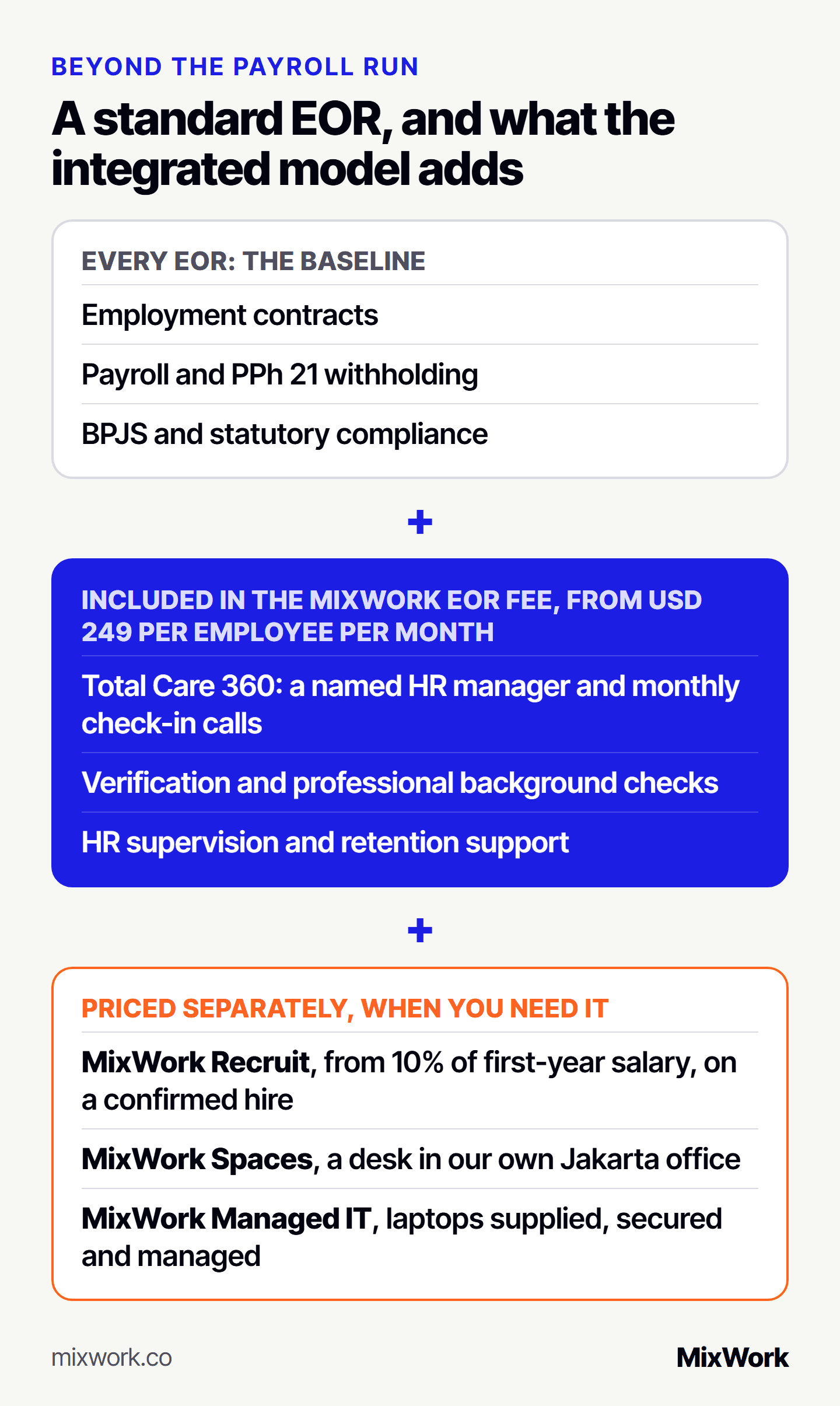
A standard EOR employs your staff and runs contracts, payroll and statutory compliance; anything beyond that is your problem or a separately priced add-on. MixWork’s integrated model adds recruitment, a named HR manager with monthly employee and client check-in calls (Total Care 360, included in the EOR fee), optional dedicated workspaces and managed devices in Jakarta, and active retention management, delivered first-party by a team physically present in Indonesia.
Why clients choose MixWork EOR
Hands-on, not ticket-based. A named HR manager in Jakarta, monthly check-ins with you and with your employee, and disputes handled in person. Total Care 360 is included, not an upgrade.
A platform built for Indonesian employment. Our own management dashboard and employee app are designed around PKWTT contracts, BPJS, PPh 21 and THR, so the software fits the law rather than the other way round.
Everything else under one agreement. Add a dedicated desk in our Kuningan office, a managed laptop or benefits above the statutory floor when you need them, administered by the same team that runs your payroll.
Indonesia specialists. We employ in one country and know it in depth: city-level minimum wages, severance under PP 35/2021, and what a counter-offer looks like in Jakarta. Offices in Singapore and Jakarta, clients from startups to enterprise.
The numbers behind it, from our own placement data for Q3 2026: twelve-month retention across our placements runs above 90%, and more than 80% of the people we place come from multinational or global-agency backgrounds. How each figure is measured is on our placement data page.
MixWork Finds Your People
If you don’t have a candidate yet, MixWork Recruit finds one. Specialised teams for IT, finance, marketing, healthcare, industrial and C-suite roles run the search, the fee is success-based, and recruiting typically takes two to three weeks to an accepted offer.
How Much Does an EOR in Indonesia Cost?
Budget the management fee, plus roughly 11% of gross salary in BPJS contributions (less on higher salaries, because some contributions are capped) and one extra month a year for THR. Management fees across the market run from around USD 199 to 599 per employee per month, depending on the provider and, far more importantly, on how much is bundled rather than billed as an add-on.
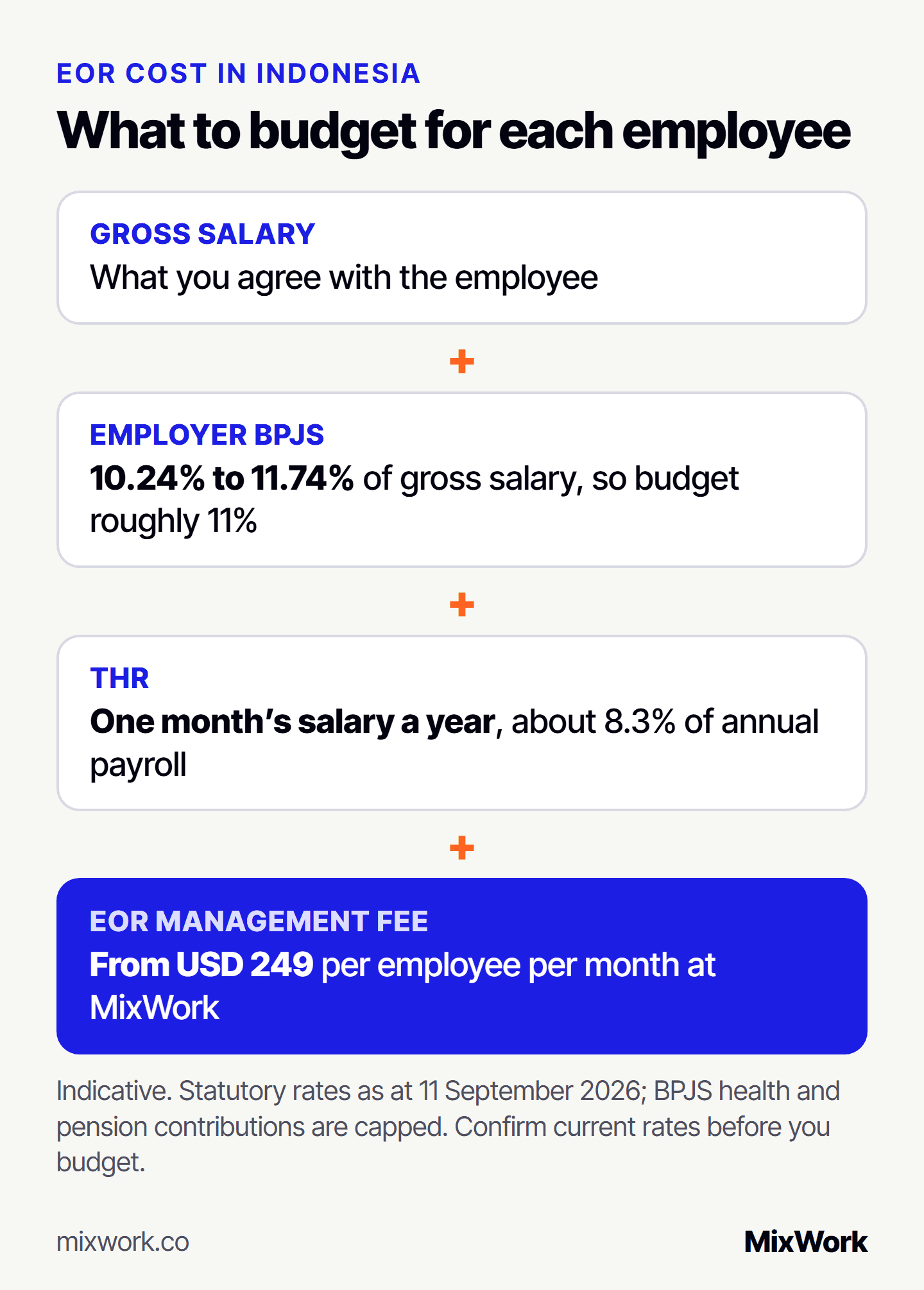
Management fees vary widely by provider type, and the headline number rarely tells the whole story. MixWork charges USD 249 per employee per month, and that fee carries Total Care 360, verification and professional background checks, HR supervision and retention support rather than metering them as extras. Talent sourcing sits outside it, charged separately and only when you actually hire someone, from 10% of first-year salary.
Deel, G-P and Remote each publish entry prices of USD 599 for compliance and payroll on their own, with sourcing, workspace, devices and engagement tooling sold separately or not offered. The comparison worth making is what each fee includes, not which headline looks smaller. Published fees, deposit terms and a change log are in our Indonesia EOR pricing index.
Who Should Use an EOR in Indonesia?
Four situations where it is clearly the right call: your first Indonesian hire, an SME building a team of five to twenty, a regulated or data-sensitive business that needs screening and a controlled workspace, and any company testing the market before committing capital to an entity. And if you would rather hand over a whole function, there is another route.
Companies That Would Rather Hand Over a Whole Function
Not every team is best built one hire at a time. If you would rather outsource an entire function, such as customer support, finance operations, back office, or data and research work, MixWork also runs BPO arrangements, where you hold us to an agreed output and service level rather than managing a headcount yourself. It is a different shape from EOR: with EOR you get named people who sit inside your team and report to your managers, while with BPO you hand the function over and we run it.
How Do You Get Started with an EOR in Indonesia?
Five steps from first call to a working colleague. Recruiting typically takes two to three weeks to an accepted offer, and the first shortlist can arrive within 24 hours. Once you have chosen your hire, EOR activation and onboarding can be done in as little as 24 hours. A 15-minute call to scope the role, sourcing and vetting if you need it, compliant onboarding covering contracts and BPJS, workspace and hardware setup, then ongoing payroll and HR management for as long as your team is in place.
The path from decision to a fully operational, compliant Indonesian team through MixWork is designed to be as fast and friction-free as possible:
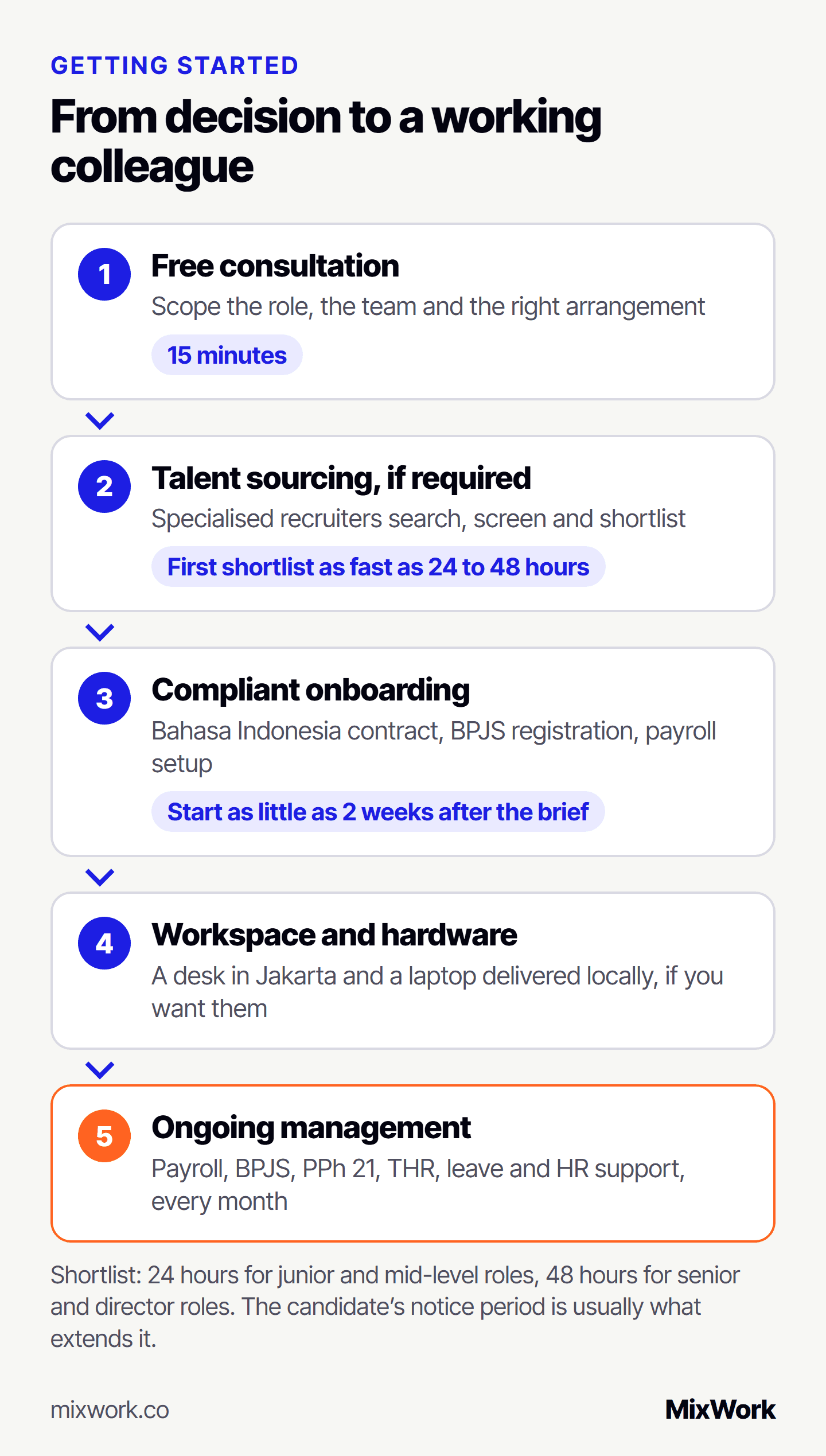
Step 1: Free Consultation. A 15-minute call establishes your hiring requirements, team context, and the roles you want to fill. MixWork advises on salary benchmarks, contract structure, and the right EOR arrangement for your needs.
Step 2: Talent Sourcing (if required). MixWork Recruit’s specialised team for the function (IT, healthcare and medical, marketing, finance, industrial or C-suite) conducts wide-net sourcing and multi-stage vetting, using proprietary data and AI tools inside MixWork’s own regional platform to narrow the field, and presents a qualified shortlist in as little as 24 hours for junior and mid-level roles and 48 hours for senior and director roles. You conduct final interviews and make the selection. From brief to accepted offer, recruitment typically takes two to three weeks.
Step 3: Compliant Onboarding. Once you have chosen your hire, EOR activation and onboarding, covering the employment contract in Bahasa Indonesia, BPJS registration and payroll setup, can be completed in as little as 24 hours. The actual start date is usually set by the candidate’s notice period with their current employer. Your new team member is legally employed, fully insured, and operationally ready.
Step 4: Workspace and Hardware Setup. If your employee will work from MixWork’s managed Jakarta office, their desk is configured. Hardware is procured and delivered locally. Your team is equipped from day one.
Step 5: Ongoing Management. Monthly payroll, BPJS compliance, PPh 21, THR, leave management, HR supervision, performance support, and dedicated account management, continuous and ongoing for as long as your team is in place.
Hire professionals who have worked at companies like these
Before joining a MixWork client, most of our professionals spent years at global and regional leaders in banking, technology, consumer goods and manufacturing. That experience is why the work you receive meets an international standard from the first week.
















Logos show companies where MixWork professionals have previously worked. They do not imply that these companies endorse MixWork.
The Bottom Line
An employer of record removes the three things that slow down a first Indonesian hire: the cost of setting up an entity, the compliance workload, and the months between deciding to hire and having someone at work. For most international companies entering Indonesia, it is the sensible place to start.
Statutory figures in this guide are current as at 11 September 2026 and provider fees were read on 17 October 2026, with official sources listed under the reference tables below. Indonesian employment rules change, and parliament passed a new employment bill in October 2026, so treat this guide as a starting point rather than legal advice and confirm current requirements with qualified Indonesian legal counsel before acting on them. Keeping up with those changes is the part we take off your hands.
Compliance is the starting point. What you are really building is a strong Indonesian team that stays.
Ready to build yours? Book a free consultation with MixWork today and have your first Indonesian hire operational within weeks.
Planning your Indonesia team?
See transparent EOR pricing | Estimate your hiring costs | Book a free consultation
2026 reference tables: BPJS, PPh 21, minimum wage and EOR fees
BPJS contribution rates, 2026
| Programme | Employer | Employee | Notes |
|---|---|---|---|
| JKK, work accident | 0.24% to 1.74% | None | Rate set by the role's risk classification |
| JKM, death benefit | 0.30% | None | Flat rate |
| JHT, old-age savings | 3.70% | 2.00% | Paid on gross salary |
| JP, pension | 2.00% | 1.00% | Capped at IDR 11,086,300 gross per month (ceiling revised March 2026) |
| BPJS Kesehatan, health | 4.00% | 1.00% | Capped at IDR 12,000,000 gross per month; covers spouse and up to three children |
| Total | 10.24% to 11.74% | 4.00% | Kesehatan by the 10th; Ketenagakerjaan by the 15th of the following month, with a 2% monthly penalty if late |
Employers register staff across both BPJS programmes within 30 days of hire. Budget roughly 11% of gross salary on top of the salary itself.
PPh 21 income tax brackets, 2026
| Annual taxable income (IDR) | Rate |
|---|---|
| Up to 60,000,000 | 5% |
| 60,000,001 to 250,000,000 | 15% |
| 250,000,001 to 500,000,000 | 25% |
| 500,000,001 to 5,000,000,000 | 30% |
| Above 5,000,000,000 | 35% |
Withheld monthly, deposited by the 15th of the following month and reported by the 20th under PMK 81/2024, with an annual true-up in the December return.
Provincial minimum wage (UMP), 2026
| Province | UMP 2026 (IDR / month) | Approx. USD |
|---|---|---|
| DKI Jakarta | 5,729,876 | ~350 |
| North Sumatra | 3,228,949 | ~197 |
| Bali | 3,207,459 | ~196 |
| Banten | 3,100,881 | ~189 |
| East Java | 2,446,880 | ~149 |
| DI Yogyakarta | 2,417,495 | ~148 |
| Central Java | 2,327,386 | ~142 |
| West Java | 2,317,601 | ~141 |
Read this one carefully before you pick a city. West Java has the lowest provincial floor in Indonesia, but the province also contains the highest city floors in the country: Kota Bekasi sets its district minimum (UMK) at IDR 5,999,443, Kabupaten Karawang at IDR 5,886,853, and Kota Bandung at IDR 4,737,678.
Hire in Bekasi and you are paying roughly 2.6 times the West Java provincial figure. The UMK, not the UMP, is the number that binds you. Effective 1 January 2026 under Government Regulation 49 of 2025 and the relevant governors' decrees. Full province-by-province detail is in our guide to Indonesia's minimum wage.
Primary sources for the statutory tables above. BPJS contribution rates: BPJS Ketenagakerjaan, contribution rates for JHT, JKK, JKM, JP and JKP under Law No. 24 of 2011, Government Regulation No. 44 of 2015 and Government Regulation No. 46 of 2015. PPh 21 brackets: Law No. 7 of 2021 on the Harmonisation of Tax Regulations, with deposit and filing dates under PMK 81/2024. Minimum wages: Government Regulation No. 49 of 2025, the second amendment to the 2021 wage regulation, which sets the formula behind every 2026 UMP and UMK decree.
EOR fees in Indonesia, provider by provider, 2026
| Provider | Published EOR fee, per employee per month | Source |
|---|---|---|
| Remote People | From USD 199 | remotepeople.com |
| MixWork | USD 249, with Total Care 360 included | mixwork.co/pricing |
| Omni HR | From USD 249 | omnihr.co/pricing |
| Glints TalentHub | From SGD 399 | talenthub.glints.com/pricing |
| Multiplier | From USD 459 billed annually, USD 499 billed monthly | usemultiplier.com/pricing |
| Deel | From USD 599 | deel.com/pricing |
| G-P | Starts at USD 599 | globalization-partners.com |
| Remote | Starting at USD 599 | remote.com/pricing |
Published entry prices read from each provider’s own pages on 17 October 2026. Most are global rates rather than Indonesia-specific figures, and statutory employer costs (BPJS and THR) come on top with every provider. What each fee includes matters more than the headline number. Deposit terms and a change log are in our Indonesia EOR pricing index, and the side-by-side comparison is in best EOR companies in Indonesia.
Frequently Asked Questions
Related guides
• How much does an EOR in Indonesia cost? 2026 pricing
• Is an Employer of Record legal in Indonesia?
• PT PMA vs EOR: which gets you hiring faster?
• How to hire contractors in Indonesia compliantly
• Indonesia employment & outsourcing glossary
• Outsourcing to Indonesia: the 2026 guide
• Use the hiring cost calculator
• Outsourcing software development to Indonesia
• Best EOR companies in Indonesia, compared
• Hiring a technical support team in Indonesia
• EOR vs PEO: differences, costs and the Indonesia answer
Hire by role
• Hire IT developers and software engineers in Indonesia
• Hire graphic designers in Indonesia
• Hire a social media manager in Indonesia
• Hire an executive assistant in Indonesia
• Hire e-commerce and marketing operations staff in Indonesia
• Hire IT support staff in Indonesia
• MixWork Jakarta: office, workspaces and the team on the ground
• MixWork placement data: retention, profile and hiring speed (Q3 2026)
• Indonesia employment law tracker 2026: every change, dated and sourced
• Indonesia EOR pricing index: every published fee, verified monthly
• Switching EOR providers in Indonesia without losing continuity
• EOR onboarding in Indonesia: the first 14 days
• How to hire offshore developers in 2026: the five models compared
• Your first engineers in Indonesia: a 30-day plan
• Best recruitment agencies in Indonesia for international companies (2026): eight compared