If you work with contractors or freelancers in Indonesia who have become a permanent part of your team, moving them onto employment through an Employer of Record (EOR) is usually the right next step. You keep the same people and the same way of working. They gain a permanent contract, statutory health cover, pension savings and the annual THR payment, which makes them far more likely to stay. You remove the risk of treating full-time workers as contractors, and you do it without setting up a company in Indonesia.
What changes, in one line: under an EOR, the EOR becomes the legal employer on a compliant Indonesian permanent contract and handles payroll, tax, BPJS and HR, while you keep directing the work exactly as you do today.
Where this guide comes from
MixWork recruits and employs professionals in Indonesia for international companies. This guide is for companies whose Indonesian contractors started on a short project and stayed, and it follows the process we take clients through when they convert. MixWork EOR employs on permanent full-time contracts only, so we also say plainly below when keeping a contractor is the better choice.
Signs it is time to move from contractors to an EOR
It is time to switch when the contractor relationship looks like employment in everything but the paperwork. If two or more of these describe your setup, an EOR will serve you better:
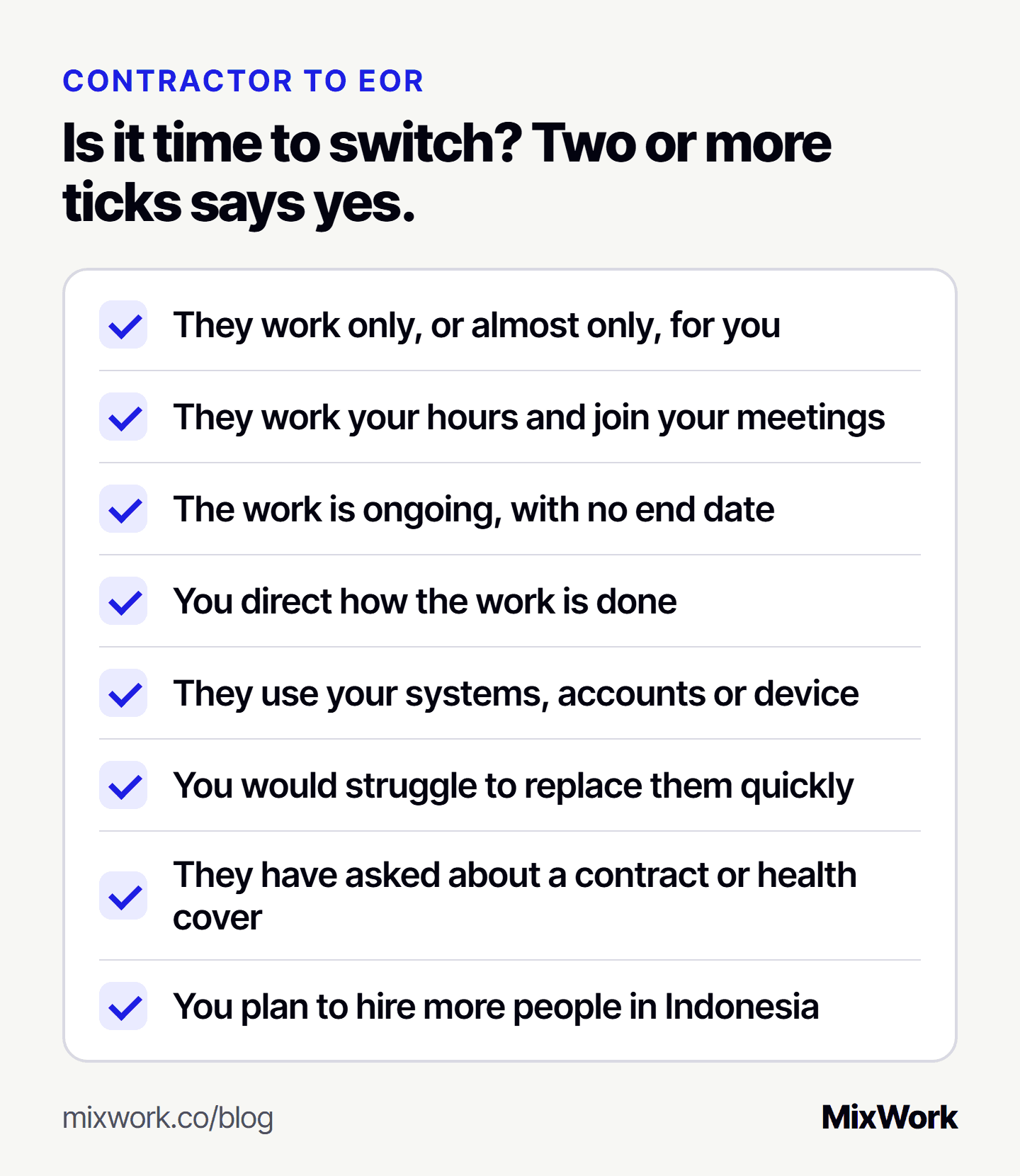
They work only, or almost only, for you.
They work your hours and join your team’s meetings and channels.
The work is ongoing, with no project end date.
You direct how the work is done, not just what is delivered.
They use your systems, accounts or a device you sent them.
You would struggle to replace them quickly if they left.
They have asked about health cover, a contract or “being made permanent”.
You want to hire more people in Indonesia and want a proper structure first.
Where the line sits legally, and what the exposure looks like if a contractor is really an employee, is covered in hiring contractors in Indonesia. This guide is about what to do next.
What changes when a contractor becomes an employee
Day to day, your side barely changes: you still direct the work. The person gains a permanent contract, statutory benefits and an HR team behind them.
Contractor or freelancer | Employee through an EOR | |
|---|---|---|
Legal relationship | Commercial service agreement | Indonesian permanent employment contract |
Who employs them | Nobody; they are self-employed | The EOR, as legal employer |
Who directs the work | Strictly, they do, to your brief | You do, as now |
How they are paid | Invoices, often in USD, often through a platform or international transfer | Monthly payroll in rupiah, with tax withheld and filed |
Health cover and pension | They pay for their own | Both BPJS schemes, registered by the EOR |
THR and paid leave | None | THR of one month’s salary a year, plus statutory annual leave |
Protecting your data | Whatever the service agreement says | Employment contract with non-disclosure and data-protection terms |
HR support | None | The EOR’s HR team, for them and for you |
How you pay | One invoice per contractor | One monthly invoice for the whole team |
Your risk | Exposure if they are really employees, which grows with tenure | A compliant employment contract from the start date |
Why switching your contractors to an EOR pays off
The strongest reason to switch is to keep the people you have already invested in. A contractor who has spent two years learning your product, your clients and your standards is worth far more to you than their invoice suggests, and they are also the person most exposed to a better offer. Experienced Indonesian professionals, particularly those with multinational backgrounds, generally prefer permanent employment: it brings health cover for them and their dependants, pension savings and THR, and it makes a mortgage or a lease easier to secure. Offering a permanent contract before a competitor does is one of the most effective retention measures available to you.
The switch also stops you carrying risk you may not have priced. An arrangement that has quietly become full-time employment is replaced by a compliant contract from the start date, as set out in hiring contractors in Indonesia.
You also get their full attention. Contractors and freelancers usually work for several clients at the same time, so your work competes with someone else’s for the same hours, and a new client can appear without you knowing. As an employee, their working week is yours, and MixWork EOR employment contracts include a clause on outside work and conflicts of interest. That turns moonlighting from something you hope is not happening into something agreed in writing.
It changes who you can hire next. When you grow the team, a permanent offer reaches candidates a contract offer does not. The professionals MixWork places average six years’ experience, and more than 80% come from multinational or global-agency backgrounds; in our experience, few of them will consider a contractor arrangement.
Retention improves, and retention is where the money is. Gallup’s US estimate puts the cost of replacing an employee at between one-half and two times their annual salary, a figure it calls conservative. Across MixWork’s own placements, twelve-month retention runs above 90%, measured on our own placement data.
Admin falls. Instead of paying several contractors in several ways, you receive one monthly invoice, and payroll in rupiah, income tax withholding and filing, BPJS registration and contributions, THR and leave records become the EOR’s job.
Your monthly cost will rise above the old invoices, because you are now paying for benefits the contractor previously went without. Even so, six years of multinational experience in Jakarta costs a fraction of the same experience in Singapore, Sydney, London or New York, after statutory costs and the EOR fee. Our cost calculator shows the all-in monthly figure for a specific salary.
Contractor to employee salary conversion in Indonesia
Start from the take-home pay the person should receive, not from their contractor rate. A contractor’s invoice and an employee’s salary are different things, and copying one into the other is a common mistake in a switch.
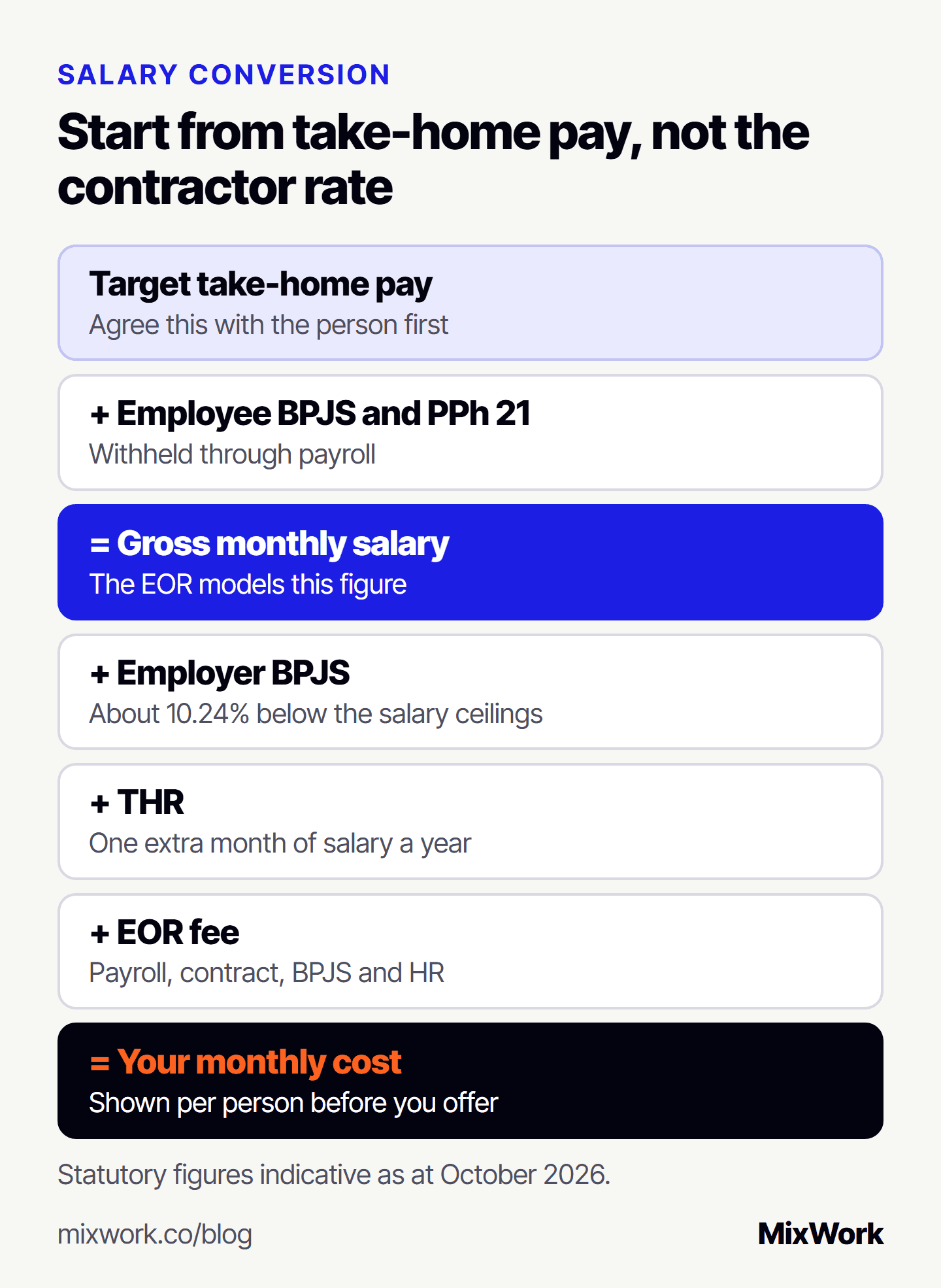
As a contractor, the person received your full fee and was responsible for their own tax, health cover and savings. As an employee, four things change between the gross salary, their take-home and your cost:
The employee’s share of BPJS is deducted: 1% for health (BPJS Kesehatan) and 2% for old-age savings (JHT), plus 1% for pension (JP), with salary ceilings on health and pension.
Income tax (PPh 21) is withheld through payroll every month.
The employer pays its own BPJS contributions on top: roughly 10.24% of salary for a standard office role, which never appears on the payslip.
THR is paid to the employee: one extra month’s salary a year, taxed as income. It raises their annual take-home and your annual cost.
Together, employer BPJS and THR add roughly 15 to 19% to your cost, depending on pay: the higher end below the BPJS salary ceilings, the lower end for salaries of IDR 20 to 30 million a month.
So the practical method is:
Agree a target monthly take-home pay with the person. A fair starting point is roughly what they keep today, with THR and the benefits as the improvement.
Ask the EOR to model the gross salary that produces that take-home after BPJS and PPh 21, and the full monthly cost to you including employer contributions, THR and the EOR fee.
Agree whether the offer is quoted gross or net. Indonesian professionals often discuss pay as take-home. Writing both figures into the offer avoids a misunderstanding on the first payslip.
Decide how you recognise their history with you. Their years as a contractor can be reflected in salary and title.
All statutory figures here are indicative as at October 2026, and the detail is in how much BPJS costs employers and what THR is and how it is calculated. MixWork models each conversion person by person before you make an offer.
How the switch works, step by step
A contractor-to-EOR switch can be planned in a few days and completed at a month end. The sequence we use:
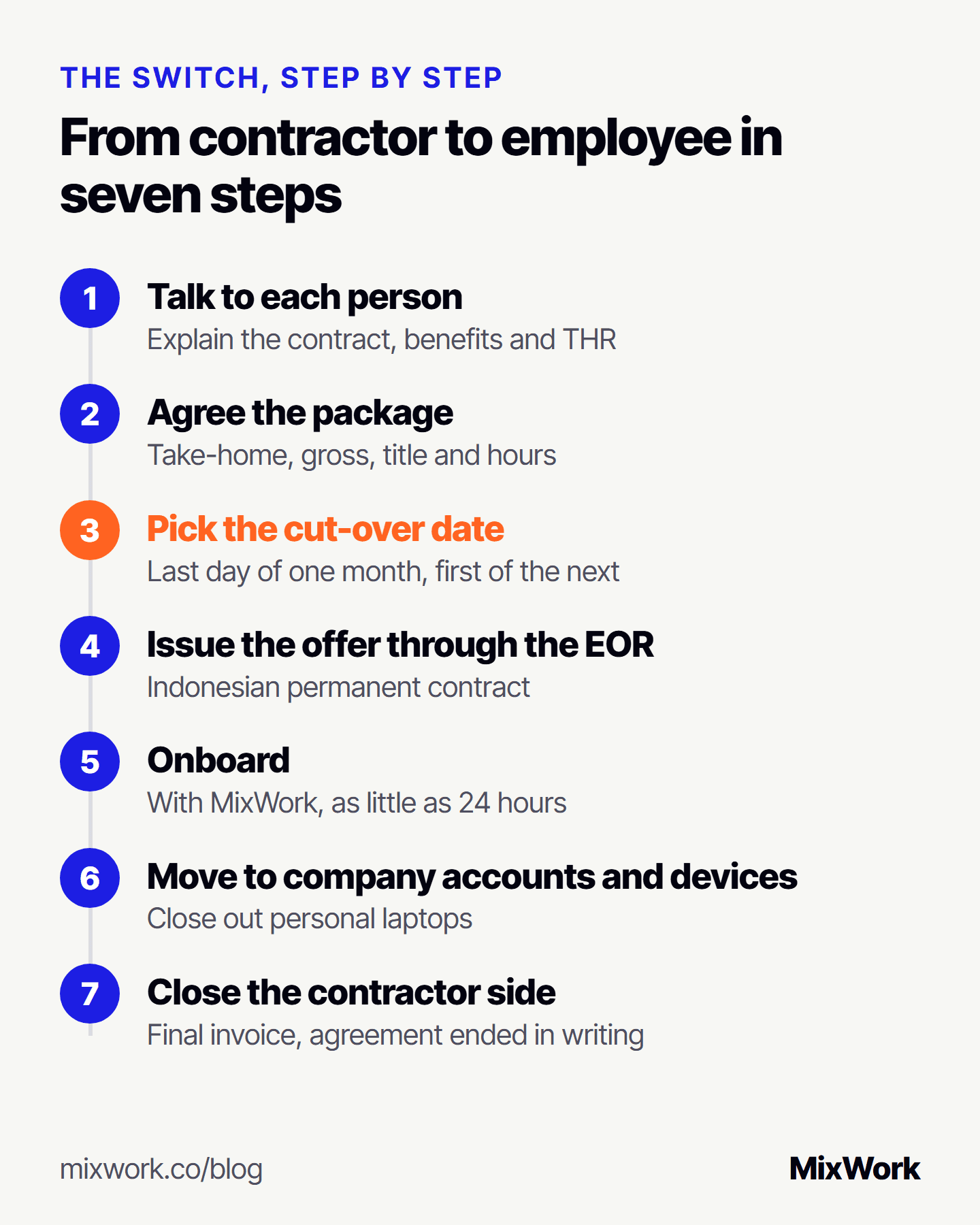
Talk to each person first. Explain why you are offering employment and what it means for them: a permanent contract, health cover, pension savings, THR and paid leave. Give them time to think about the change from invoice to payslip, and to ask questions.
Agree the package using the conversion method above, and confirm the job title, working hours and reporting line.
Pick the cut-over date. The cleanest approach is to end the contractor agreement on the last day of a month and start employment on the first of the next, which keeps payroll and final invoices simple.
Issue the offer through the EOR. The EOR issues a permanent Indonesian employment contract, including confidentiality and data-protection terms.
Onboard. With MixWork EOR, activation and onboarding can take as little as 24 hours once the offer is accepted, and BPJS registration is submitted and completed within the same window.
Tidy up access and equipment. If the person has been working on their own laptop, this is the moment to move them to a managed company device and company accounts.
Close the contractor side. Settle the final invoice, end the service agreement in writing, and close any freelance platform contract. If you met them on a marketplace, check its terms: some charge a fee to move a relationship off the platform.
For a group of contractors, switch them together on the same date. One cut-over is simpler for payroll and sends a clear message to the team. What the first two weeks look like is set out in the first 14 days with an EOR in Indonesia.
When to keep a contractor
Keep a contractor where the work is genuinely a project. A defined deliverable, a specialist you need for a few weeks, irregular work that comes in bursts, or someone who runs their own business and serves many clients: these are proper contractor relationships, and moving them to employment would not serve either side. A common setup is a permanent core team employed through an EOR, with freelancers brought in for projects around it. MixWork employs on permanent full-time contracts only, so we do not manage those freelance arrangements, and we will tell you if one should stay as it is. For the wider comparison, see freelancer vs full-time employee.
What to look for in an EOR partner when you convert a team
Choose an EOR that can help you keep and grow the team as well as pay it. The structure you set up now is the one every future hire in Indonesia will join. Ask any provider:
Who will your people actually talk to? A named HR contact backed by a team on the ground in Indonesia, or a ticket queue?
Can they help you hire the next person? Most EOR providers expect you to arrive with the candidate already chosen.
What happens above the statutory floor? Benefits, workspaces, devices and learning are what keep converted contractors from leaving in year two.
Is it all under one agreement? Or will workspaces, devices and benefits come from separate suppliers with separate invoices?
How deep is their Indonesian expertise? City-level minimum wages, THR timing, Ramadan scheduling and Jakarta counter-offers are where specialist depth shows.
Why MixWork is the right partner for the switch
We think MixWork is the strongest choice for a company moving an Indonesian contractor team onto employment, because we cover the whole job: hiring the people you need next, employing the people you have, and looking after both. This is our view, not an audited ranking, so here is what it rests on.
We recruit as well as employ. Most EOR providers expect you to arrive with the candidate already chosen. MixWork Recruit runs specialised teams for IT, healthcare and medical, marketing, finance, industrial roles and C-suite search, with a first shortlist as fast as 24 hours for early-career and mid-level roles and 48 hours for senior roles. The team you convert today can grow without a second supplier.
Hands-on HR from Jakarta, not a ticket queue. Every MixWork EOR engagement includes Total Care 360 at no extra cost: a dedicated HR manager backed by a full HR team, monthly check-in calls with each employee and separate monthly calls with you, and support with engagement, performance and any dispute. For people moving from contracting, having someone to call is often the biggest change.
Everything under one agreement. Add a desk in our own offices through MixWork Spaces, a managed laptop through MixWork Managed IT with devices held in the region, and benefits above the statutory floor through MixWork Flex Benefits. Same team, same invoice.
A platform built for Indonesian employment. Our own dashboard and employee app are designed around Indonesian permanent contracts, BPJS, PPh 21 and THR.
Indonesia specialists. We specialise in one country rather than a hundred, with offices in Singapore and Jakarta and clients from startups to enterprise teams.
Retention you can measure. Twelve-month retention across our placements runs above 90%, on our own placement data.
What we do not do: MixWork employs on permanent full-time contracts only, and we do not offer contractor or contractor-of-record services. If part of your team should stay on contract, we will say so.
To plan a switch for your team, book a call and we will model the conversion for each person before anything changes.
Statutory figures in this guide are indicative as at October 2026 and are not legal advice. Your EOR, or local counsel for a specific case, confirms the position.