A freelancer is the better hire for a defined project with an end date. A full-time employee is the better hire for ongoing work that you direct, that needs your business context, and that you want done the same way next year. The freelancer’s hourly rate usually looks cheaper. Measured per productive hour that actually reaches your work, a full-time professional is often the better value: their working week is yours, and what they learn stays in your business for as long as they do.
In short: a freelancer sells you hours or outcomes and remains their own business. A full-time employee works only for you, under your direction, and builds knowledge that stays with your company. For international employers without a local company, an Employer of Record (EOR) makes the second option possible: it employs the professional on a compliant permanent contract, runs payroll and statutory benefits, and you manage the work.
Where this guide comes from
MixWork recruits and employs professionals in Indonesia for international companies, from startups and SMEs to enterprise teams. We have placed more than 100 professionals in remote roles across IT, fintech, healthcare, marketing, retail, e-commerce and other industries. MixWork offers permanent full-time employment only. We do not provide freelancer or contractor services, which is worth knowing as you read: this guide argues for the model we sell, so we have been specific about when a freelancer is the better choice.
Freelancer vs full-time employee: the differences that matter
The core difference is who the person works for. A freelancer runs their own business and sells you part of their time or a finished deliverable. A full-time employee works for you, under your direction, and the knowledge they build stays in your company.
Freelancer | Full-time employee (through an EOR) | |
|---|---|---|
Who they work for | Their own business, usually several clients at once | Your company only |
Availability | The share of their week they sell you | A full working week |
Who directs the work | They decide how and when, to an agreed brief | You set priorities, methods and hours |
Business context | Rebuilt for each new project, and leaves with them | Accumulates month after month and stays with you |
How long it lasts | Ends when the project or contract ends | Permanent. Ending it follows Indonesian termination rules, including severance, which the EOR handles |
Benefits and leave | None from you; they fund their own | Statutory health cover, pension savings, THR and paid leave, run by the EOR |
Protecting your data | Whatever their contract says, on their own devices | Employment contract with non-disclosure and data-protection terms; company device if you provide one |
Who handles HR issues | Nobody; it is a commercial relationship | The EOR’s HR team, with you |
Cost structure | Hourly, daily or per project, plus any platform fees | Monthly salary plus statutory on-costs plus one EOR fee |
Best for | One-off projects, specialist bursts, testing a need | Core, ongoing roles you want done well for years |
Why the hourly rate is the wrong comparison
Compare the cost of each productive hour that reaches your work, not the rate on the invoice. A freelancer’s rate is often higher per hour than a salary works out to, yet many employers still choose the freelancer because they pay only for the hours used. That logic holds for short projects and breaks down for ongoing work, for four reasons.
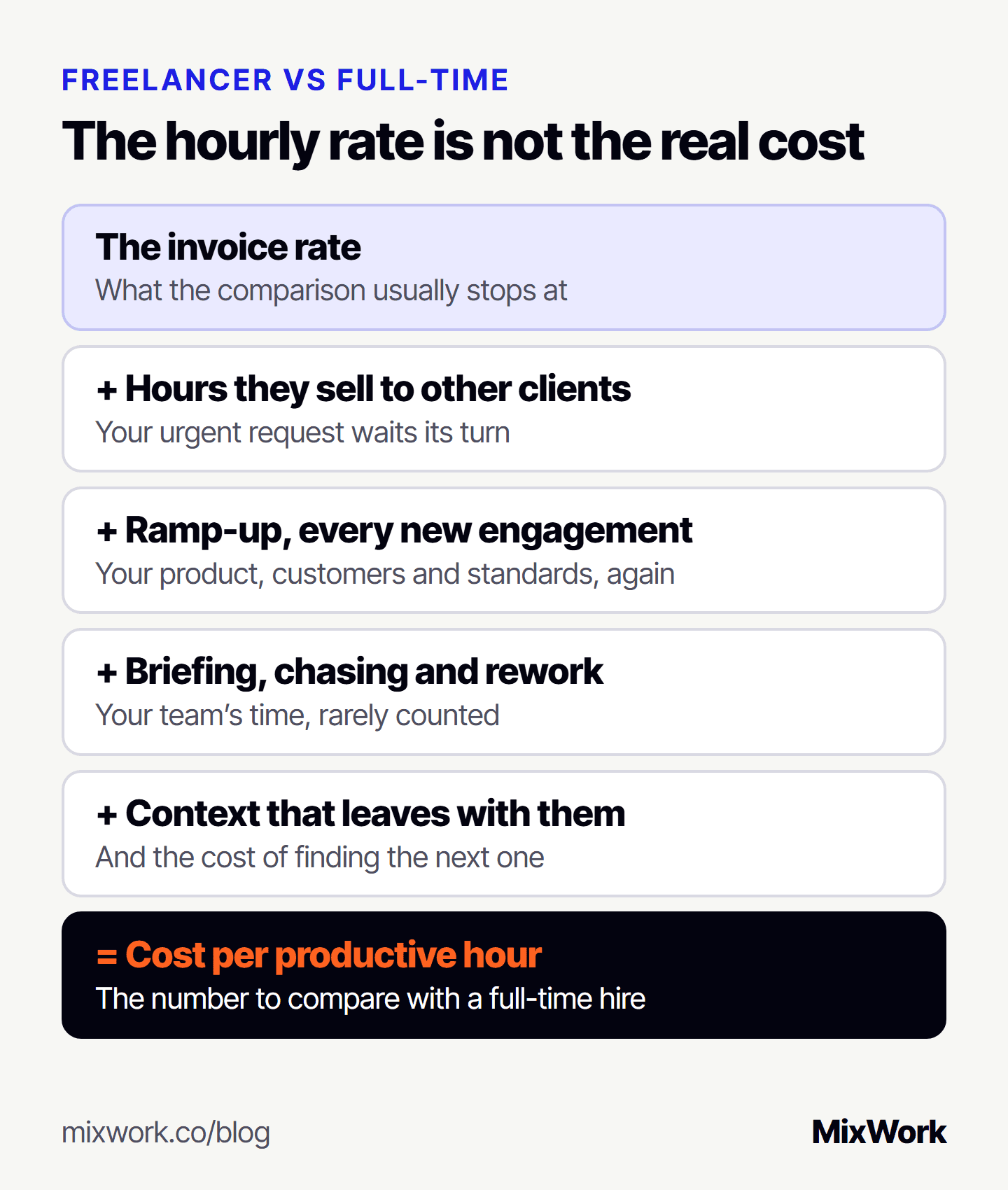
Availability. A freelancer with three clients sells each of them part of a week, and your urgent request competes with theirs. A full-time professional’s week belongs to you.
Ramp-up, repeated. Every new freelancer has to learn your product, your customers and your standards. With a project freelancer you pay for that learning every time you start a new engagement. With an employee you pay for it once.
Rework and coordination. Briefing, reviewing and correcting work from someone who does not carry your context takes your team’s time, and that time rarely appears in the comparison.
Context that walks out. When a freelancer moves on, the knowledge of how your systems fit together and why decisions were made leaves with them. An employee who stays turns that knowledge into speed.
A simple test. Add up the hours you spend briefing, chasing and reworking a freelancer’s output in a typical month, and the days lost each time you find and onboard a new one. Add that to the invoices. Then compare it with what a full-time professional costs on our cost calculator. For ongoing work, the full-time figure is often the lower one.
What a full-time professional gives you that a freelancer cannot
A full-time professional takes ownership of the work, not just the brief. A freelancer delivers what was asked for. An employee who owns a function notices what the brief left out, fixes the process that keeps producing the same problem, and is still there to answer for the result next quarter.
Ownership builds on knowledge that only accumulates in people who stay: which clients need careful handling, how your internal tools fit together, why a decision was made two years ago. It also makes access easier to grant. Customer data, finance systems, source code and client relationships are simpler to open to someone on an employment contract with confidentiality and data-protection terms, working on a managed company device, than to a rotating set of outside suppliers.
An employee can also grow. You can train them, widen their responsibilities and eventually build a team around them, and you know what capacity you have next quarter. A freelancer can take on a bigger client or raise their rate at short notice, and you tend to find out when it happens.
A full-time hire also deals with moonlighting. Most freelancers work for several clients at once, which is how freelancing works, so part of their week always goes to someone else’s priorities, and they can add another client without telling you. A full-time employee’s working hours are yours, and MixWork EOR employment contracts include a clause on outside work and conflicts of interest. Whether they take on side work stops being something you hope about and becomes something agreed in writing.
The people worth hiring want permanent employment
In Indonesia, the most experienced professionals generally prefer permanent employment, so a freelance-only offer filters out the candidates you most want. Permanent employment brings statutory health cover through BPJS Kesehatan, old-age savings and pension through BPJS Ketenagakerjaan, and the annual THR payment of one month’s salary. None of that comes with a freelance contract. Professionals who have spent years inside multinationals know what they would be giving up, and many have dependants on their health cover. Permanent employment also makes a mortgage or a lease easier to secure.
The professionals MixWork places reflect this. They average six years’ experience, and more than 80% come from multinational or global-agency backgrounds. They write to clients and present to stakeholders in English without anyone reviewing their messages first, and they use AI tools daily as standard. We cover why this group declines freelance work in more detail, with the full benefits arithmetic, in Integrated Outsourcing vs Freelance Contracting.
Freelancing suits plenty of people, particularly for project-based work. For a senior role that needs judgement and continuity, though, a permanent offer is often what gets the right candidate to say yes.
What a full-time hire actually costs on top of salary
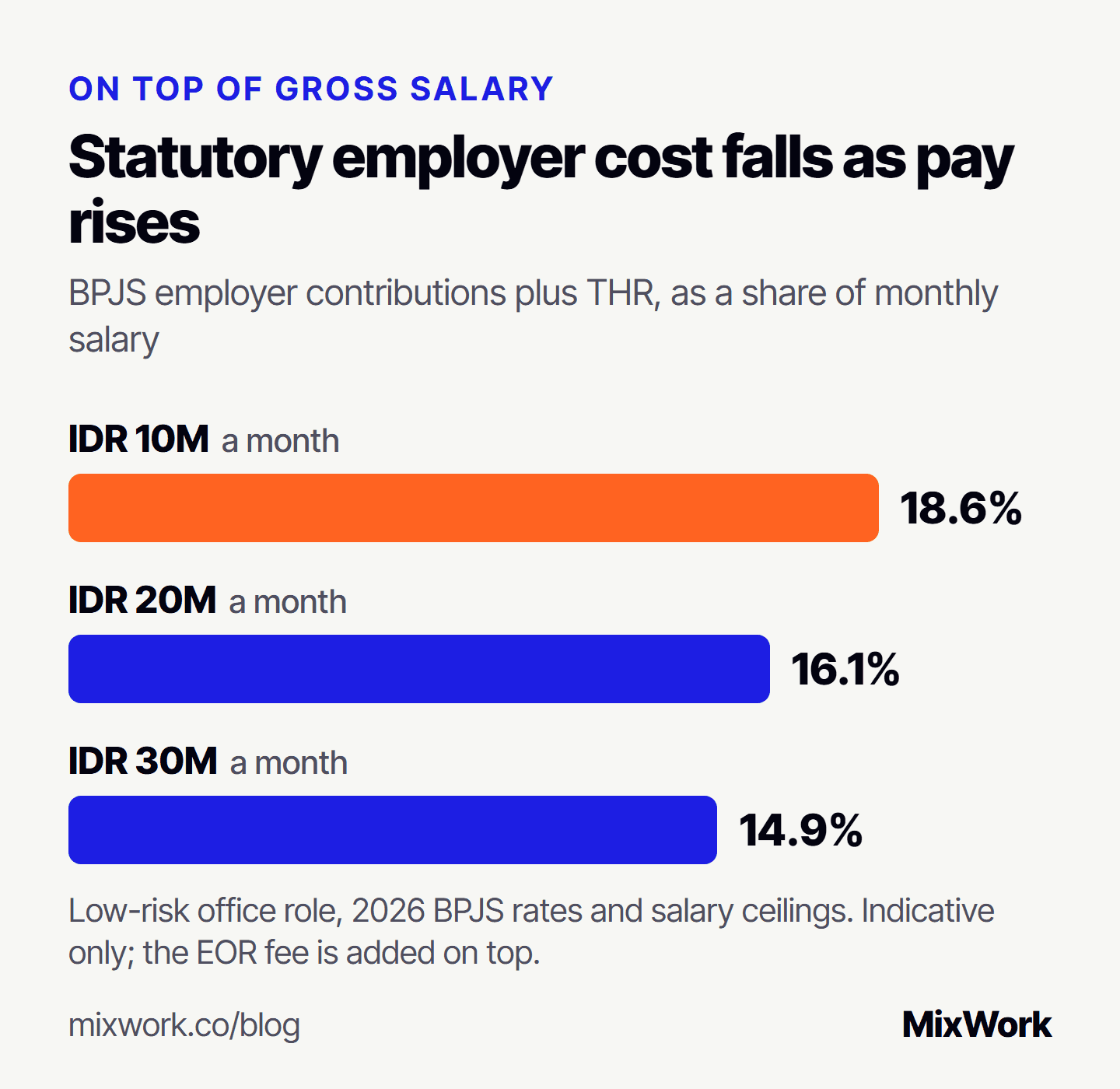
On top of gross salary, statutory employer costs for an office employee in Indonesia come to roughly 15 to 19%, depending on pay, plus the EOR’s fee. Two things make up the statutory part. BPJS contributions run at about 10.24% of salary for a low-risk office role (health, old-age savings, pension, death and work-accident cover), and THR, one extra month’s salary a year, adds about 8.3% of annual base salary. Health and pension contributions stop at salary ceilings, so the effective rate falls as pay rises: about 18 to 19% below roughly IDR 11 million a month, about 16% at IDR 20 million and about 15% at IDR 30 million.
Permanent employment also means that if it ends, Indonesian termination rules apply, including severance. The EOR handles the process, and the cost is the employer’s.
These figures are indicative as at October 2026, calculated on the BPJS rates and ceilings in force in 2026, and your EOR confirms them for each hire. The detail sits in how much BPJS costs employers and what THR is and how it is calculated.
The EOR’s fee buys the employment itself: the compliant permanent contract, monthly payroll and tax filing, BPJS registration and HR support. With MixWork EOR, Total Care 360 is included at no extra cost, which means a dedicated HR manager backed by a full HR team and separate monthly check-in calls with your employee and with you. Current rates are on our pricing page.
Why staying power is where full-time pays for itself
Turnover is the cost that decides the comparison. Gallup’s US estimate is that replacing an employee costs between one-half and two times their annual salary, a figure Gallup calls conservative. Every time a freelancer moves on, you pay a version of that cost: finding someone new, briefing them, and absorbing the slower weeks while they learn.
Indonesia’s labour market works in your favour here. Aon’s 2026 Salary Increase and Turnover Study, published in September 2026, puts Indonesian attrition at 15.5% for 2026, the lowest of the six Southeast Asian markets in the study. Aon’s figure covers all leavers across all industries, so it is not a like-for-like comparison with US quits data, but the gap is wide: US professional and business services ran at roughly 28% voluntary quits in 2025 (US Bureau of Labor Statistics JOLTS data, 2.3% a month multiplied by 12).
Retention also depends on the employer. Across MixWork’s own placements, twelve-month retention runs above 90%, measured on our own placement data. We put that down to what surrounds the job: Total Care 360’s dedicated HR team, regular learning sessions on new AI and software tools and, for clients who add them, benefits above the statutory floor and a desk in our offices. The full model is in the true cost of offshore turnover and how to build an offshore team that stays.
When a freelancer is the right choice
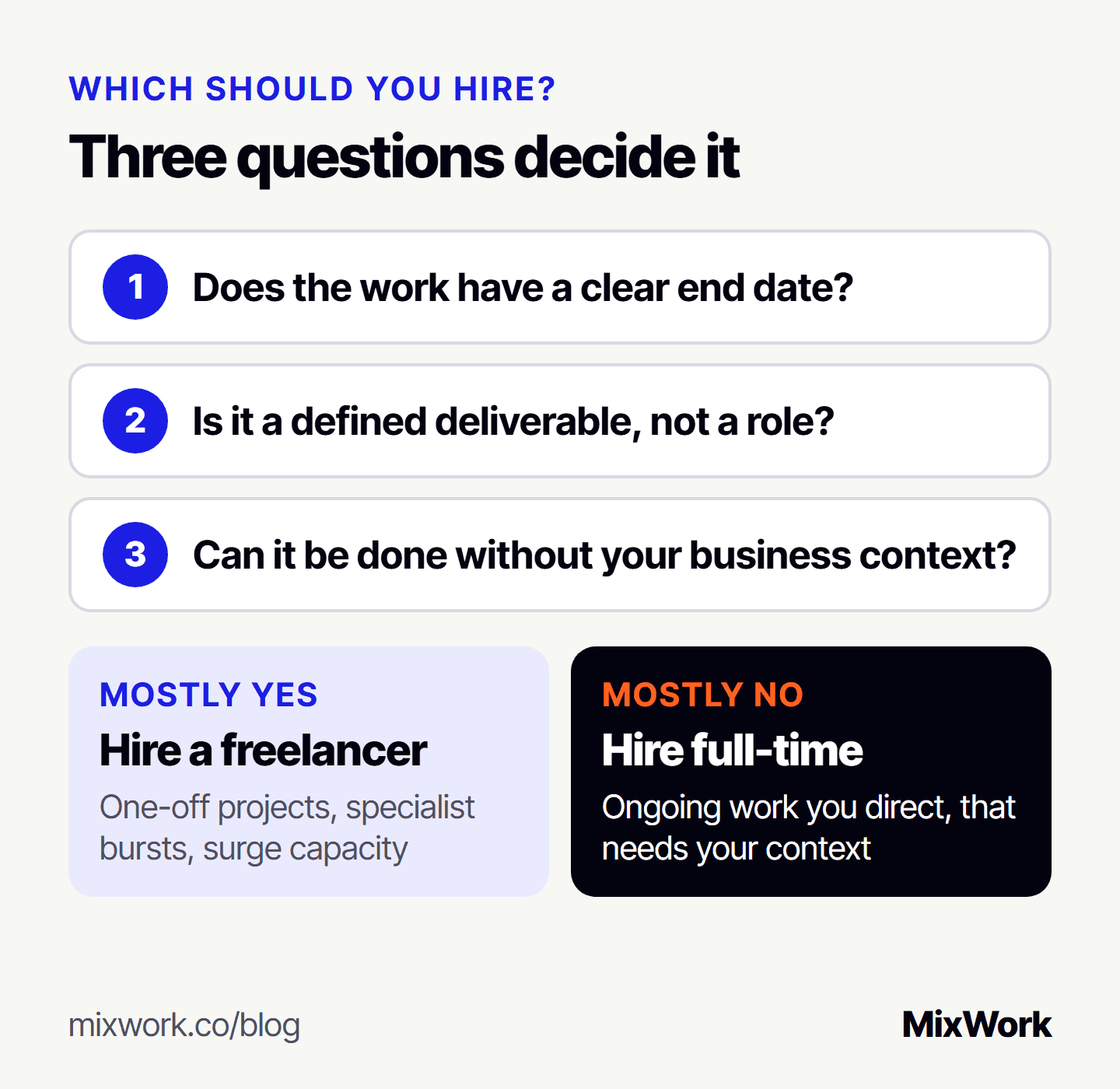
Hire a freelancer when the work has a clear end, a clear deliverable, and does not need someone inside your business. We would recommend a freelancer, not a full-time hire, in these situations:
A one-off project with a defined output: a brand identity, a website build, a data migration, a market study.
A specialist skill you need for weeks, not years: a security review, a specific integration, a translation.
Irregular volume: work that arrives in bursts with long quiet periods in between.
Testing whether a role is needed: a short engagement to learn what the job really involves before you write the job description.
Surge capacity: extra hands for a launch or a seasonal peak, alongside a permanent core team.
A strong pattern for growing companies is both: a small permanent team that owns the core work and holds the knowledge, with freelancers brought in for defined projects around it.
The warning sign: a full-time freelancer
If a freelancer works your hours, on your priorities, month after month, with no end date, you are treating them as an employee without employing them. It is worse than either option. You carry the misclassification risk of treating a contractor as an employee, and the professional has none of the security that keeps good people in place, so they are likely to leave for the first permanent offer that values their experience.
How Indonesia treats this, and where the line sits, is covered in hiring contractors in Indonesia. The practical point is simple: if the work has become a job, make it one.
How to move a freelancer to full-time employment in Indonesia
You can move a freelancer you already work with onto a permanent contract through an EOR, without setting up a company in Indonesia. In outline:
Agree a monthly salary in rupiah, starting from the take-home pay they should receive, not from their freelance rate. The EOR works out the gross salary and your full cost.
Check your marketplace terms. If you met the professional on a freelance marketplace, its terms may require a fee to hire them directly. Upwork, for example, charges a one-time conversion fee of 13.5% of the freelancer’s estimated annual earnings (their hourly rate multiplied by 2,080 hours) if you move the relationship off the platform within its first two years, less any time-based or spend-based discounts (Upwork Help Center, accessed 29 October 2026).
Issue a permanent offer through the EOR and pick a start date. A freelancer usually has no resignation notice to serve. With MixWork, EOR activation and onboarding can take as little as 24 hours once the offer is accepted.
The full method, including how to turn a contractor rate into a salary and how to plan the cut-over for a whole team, is in how to switch from contractors to an EOR in Indonesia.
If you do not have someone in mind, MixWork Recruit sources and vets candidates through specialised recruitment teams, with a first shortlist as fast as 24 hours for early-career and mid-level roles and 48 hours for senior roles.
Where MixWork fits
MixWork helps international companies hire full-time professionals in Indonesia and keep them. MixWork Recruit finds the person, MixWork EOR employs them on a compliant permanent contract, and Total Care 360 looks after them and you every month, all under one agreement. We offer permanent full-time employment only. If what you need is a freelancer for a defined project, a freelance marketplace is the right place to look, and we will tell you so.
To talk through a role, book a call.
Statutory figures in this guide are indicative as at October 2026 and are not legal advice. Your EOR, or local counsel for a specific case, confirms the position.