Recruitment Agency in Indonesia: The 2026 Guide
Six things to settle before you brief any recruitment agency in Indonesia
Agree these six points with any agency, in writing, before the search starts.
01
Who will employ the person
An agency finds; it does not employ. If you have no Indonesian entity, decide now whether an employer of record will hold the contract, or the shortlist goes nowhere.
02
The licence
Placement agencies in Indonesia operate under an LPTKS licence. Ask which licensed entity will handle your placement, and check it before you sign.
03
The fee, in writing
Percentage of what, paid when, and what the replacement guarantee covers. Most agencies do not publish schedules, so the quotation is the only document you will have.
04
Seniority in Indonesian terms
A manager title in Jakarta can mean a first-line lead or a head of function. Brief on scope and years inside multinationals, not on the title.
05
How English is assessed
Ask for the method, not the label. A live conversation on a work topic and a written exercise tell you more than a proficiency score.
06
What happens after day one
Recruitment ends at the start date. Retention is what you are paying for. Ask who checks in with the employee in month three, and whether that is included.
Hire professionals who have worked at companies like these
Before joining a MixWork client, most of our professionals spent years at global and regional leaders in banking, technology, consumer goods and manufacturing. That experience is why the work you receive meets an international standard from the first week.
















Logos show companies where MixWork professionals have previously worked. They do not imply that these companies endorse MixWork.
Recruitment Agency in Indonesia for International Companies: Fees, Process and Timelines in 2026
By the MixWork Team · Last updated 3 October 2026
Key takeaways
• Five different businesses are called a recruitment agency in Indonesia. A foreign company hiring people to work in Indonesia needs a licensed placement agency or an integrated recruitment and employer of record partner, not a migrant-worker agency.
• Job boards cost a few hundred dollars per posting; agency fees are a percentage of first-year salary and are rarely published. Two providers publish a rate for recruitment plus employment: Glints TalentHub at 18% and MixWork from 10% of first-year salary.
• A recruitment agency on its own cannot employ the person for you. Without an Indonesian entity you need an employer of record, or a provider that recruits and employs: MixWork does both, and adds the workspace, laptop and benefits around the hire.
• A first shortlist arrives as fast as 24 hours for early-career and mid-level roles and 48 hours for senior and director roles, and a hire can start as little as two weeks after the brief. The candidate’s 30-day notice period, not the search, is what stretches it.
• The professionals MixWork places average around six years of experience, more than 80% come from multinational or global-agency backgrounds, and twelve-month retention across our placements runs above 90%.
Five things called a "recruitment agency" in Indonesia, and which one you need
| Type | What it does | Who employs the person | Right for a foreign company when |
|---|---|---|---|
| Contingency recruitment agency | Sources and shortlists; paid only on a hire | You, through your own Indonesian entity | You already have a PT or PT PMA and need volume hiring for mid-level roles |
| Retained executive search (headhunter) | Direct-approach search for senior and C-level roles; paid in stages | You, through your own entity | A country head or director role where the candidate is not looking |
| Staffing or outsourcing agency (alih daya) | Supplies workers it employs itself for specified functions | The agency | Non-core functions at volume; regulated by PP 35/2021 |
| Manpower or migrant-worker agency (P3MI) | Places Indonesian workers in jobs abroad | The overseas employer | Never, if you are hiring people to work in Indonesia; this is the wrong search result |
| Integrated recruitment and employer of record | Sources, screens and then employs the person for you on a compliant Indonesian contract | The EOR | You have no Indonesian entity and want professional staff who stay |
Private placement agencies operating in Indonesia hold a licence as an LPTKS (Lembaga Penempatan Tenaga Kerja Swasta) under Manpower Law 13/2003 art. 37 and Permenaker 39/2016, and may charge placement fees only to the employer and to specified senior job categories, not to ordinary job seekers (Law 13/2003 art. 38). Ask any agency which licensed entity will handle your placement.
What recruitment costs in Indonesia, by route
| Route | Fee | Basis | Employment included |
|---|---|---|---|
| Job boards, run in-house | USD 100 to 400 per posting | JobStreet, Glints, Kalibrr, LinkedIn | No |
| Contingency agency | A percentage of first-year salary; rarely published | Ask for the schedule in writing | No |
| Retained executive search | Usually higher than contingency; invoiced in stages | Ask for the schedule in writing | No |
| Glints TalentHub | 18% of first-year salary, plus EOR from SGD 399 per employee per month | Published on talenthub.glints.com, accessed 3 October 2026 | Yes, with the EOR add-on |
| MixWork talent sourcing | From 10% of first-year salary, paid only when the hire is confirmed | Published rate card | Yes: EOR from USD 179 per employee per month, Total Care 360 on EOR Professional |
Only two providers publish their percentages; get every fee schedule in writing, including the replacement guarantee period and what triggers it. Third-party pricing changes without notice.
From brief to first day: a realistic timeline
| Stage | What happens | Typical time | What slows it down |
|---|---|---|---|
| 1. Scoping | Role, seniority, city, all-in budget including BPJS and THR, written quotation | 1 to 3 days | Undefined seniority; comparing against home-market titles |
| 2. Sourcing and screening | Direct search plus the major boards; CV screen, English and technical interviews, identity, document and background checks | As fast as 24 hours for early-career and mid-level roles, 48 hours for senior and director roles | Niche skill sets; salary anchored below market; a brief written in home-market titles |
| 3. Client interviews and offer | Two rounds is typical; offer letter with salary in rupiah | 1 to 2 weeks | Slow interview scheduling across time zones |
| 4. Notice period | Candidates in employment must give at least 30 days’ written notice | 30 days is normal; some negotiate less | Counter-offers; unpaid leave balances |
| 5. Compliant onboarding | PKWTT contract in Bahasa Indonesia, BPJS registration, payroll setup, equipment, workspace | As little as 24 hours for the contract, BPJS and payroll, inside the notice period | Missing documents; late equipment |
| Total | Brief to a working colleague | As little as 2 weeks when the candidate is available; 2 to 3 weeks plus the 30-day notice when the candidate is serving one; as little as 24 hours for EOR onboarding when you already have the person | The notice period is the long pole, not the paperwork |
Notice: PP 35/2021 art. 36 and 50. BPJS registration within 30 days of the start date: Law 24/2011. Figures current as at 11 September 2026; confirm with Indonesian counsel before relying on them.
A recruitment agency in Indonesia finds and shortlists candidates for you; it does not employ them. If your company has no Indonesian entity, that distinction decides everything, because a shortlist is only useful if someone can legally put the person on payroll. This guide explains the five kinds of business that call themselves a recruitment agency in Indonesia, how they are licensed and paid, what a realistic hiring timeline looks like, where the professional talent actually is, and how to judge a partner. It ends with how MixWork runs recruitment as the front half of an employer of record engagement, so the person you choose is employed compliantly by the same team that found them.
What a recruitment agency in Indonesia does, and what it cannot do
A recruitment agency sources candidates, screens them against your brief and presents a shortlist. In Indonesia the agency itself is a licensed private placement institution, an LPTKS (Lembaga Penempatan Tenaga Kerja Swasta), regulated under the Manpower Law 13/2003 and Ministerial Regulation 39/2016. The licence lets it charge the employer a placement fee; it may not charge ordinary job seekers, which is why a candidate paying an agency to be placed is a warning sign about the agency.
What the agency cannot do is become the employer. The offer letter, the employment contract in Bahasa Indonesia, the BPJS registration, the monthly payroll and the PPh 21 withholding all belong to a legal employer registered in Indonesia. If that is you, you need a PT or PT PMA. If it is not, the compliant route is an employer of record, which employs the person on your behalf.
Engaging the person as a contractor to avoid the question is the most expensive shortcut in Indonesian hiring, because someone working set hours under your direction for one client is an employee in substance, and reclassification brings back-dated BPJS, tax, THR and severance exposure.
Five businesses that call themselves a recruitment agency in Indonesia
The table above sets them side by side. The differences that matter to a foreign employer are these.
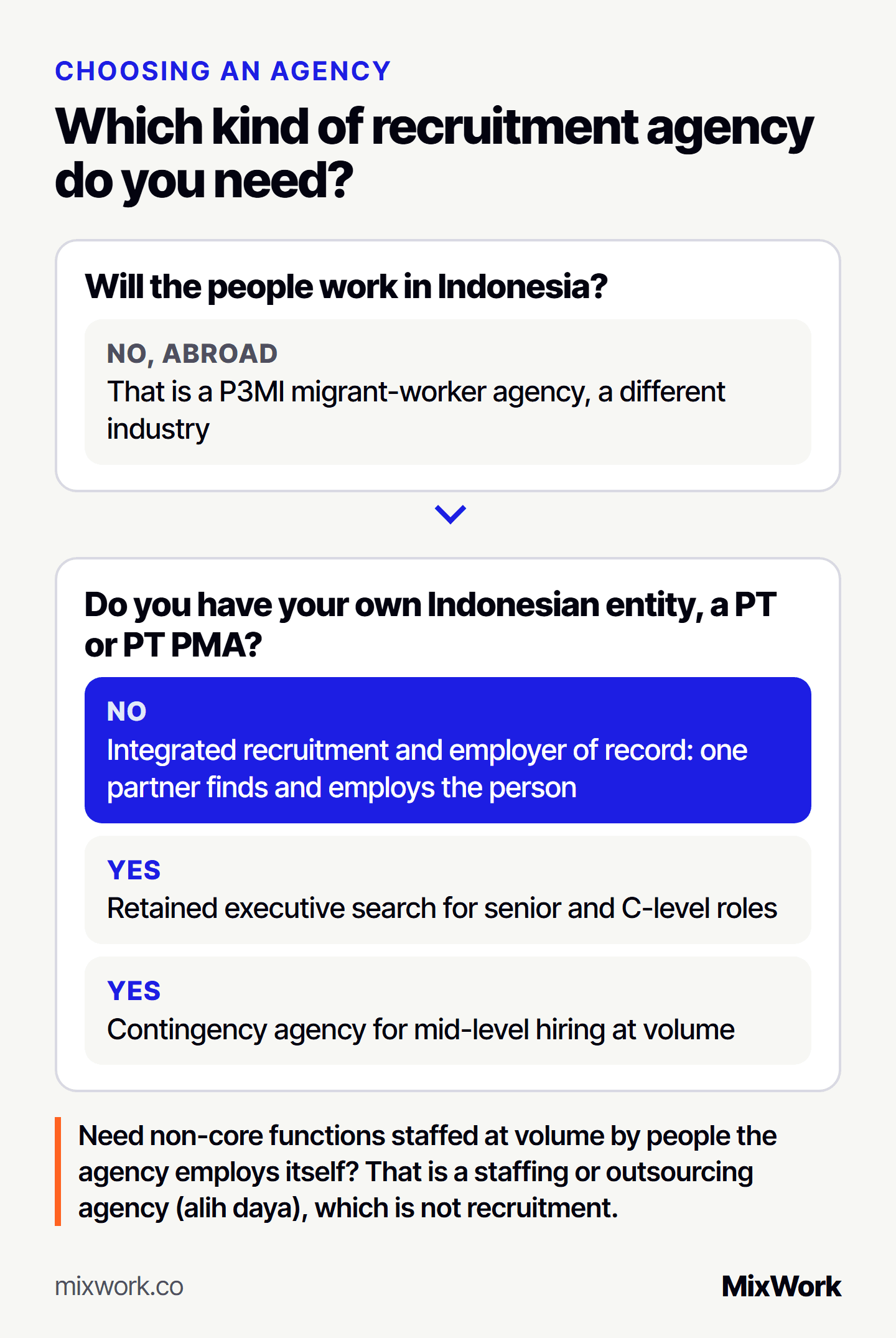
Contingency recruitment agencies
The most common model. The agency is paid a percentage of first-year salary only when you hire someone it introduced. It works well for mid-level roles where the talent pool is deep and speed matters more than exclusivity. The weakness is incentive: a contingency fee rewards speed to a hire, so ask how candidates are screened before they reach you, and the replacement guarantee is often 30 to 90 days, which is shorter than the time it takes for a bad fit to surface.
Retained executive search and headhunters
Search firms in Jakarta work senior mandates on a retained basis, approaching candidates who are not looking and invoicing in stages. The model suits a country head, a finance director or a general manager, and does not suit the individual contributors and team leads that make up most offshore teams. Fees are higher than for contingency recruitment and usually invoiced in stages, and the search takes longer by design.
Staffing and outsourcing agencies
Under Government Regulation 35/2021, an outsourcing company (alih daya) employs workers itself and supplies them to a client for specified functions. The people are the agency’s employees, not yours, and the model is built for volume and interchangeability rather than for a named professional who becomes part of your team. It is a legitimate structure with its own compliance rules, and it is not recruitment.
Manpower and migrant-worker agencies
A large share of search results for “manpower agency Indonesia” are P3MI companies that place Indonesian workers in jobs abroad under Law 18/2017 on the protection of migrant workers. If you are building a team that will work in Indonesia, this is the wrong industry entirely. It is worth knowing because the vocabulary overlaps and the two are easily confused from outside the country.
Integrated recruitment and employer of record
The provider sources and screens the candidate, then employs them for you on a compliant Indonesian contract and runs payroll, BPJS and tax in its own name. The advantage is accountability: the team that chose the person also employs them and answers for how they are doing in month six. Two providers publish a rate for this combination in Indonesia, Glints TalentHub at 18% of first-year salary and MixWork from 10%, both with an employer of record fee on top. Both also list workspace, device and benefits services around the hire.
What recruitment agencies in Indonesia charge
Fees are quoted as a percentage of first-year salary and almost never published. Contingency fees for mid-level roles and retained fees for senior ones vary by agency, so ask for the schedule in writing. Job boards cost a few hundred dollars per posting and leave the screening to you. The published exceptions are Glints TalentHub at 18% and MixWork from 10% of first-year salary, paid only when the hire is confirmed.
The percentage is not the whole cost. Ask what the fee is calculated on (base salary or total first-year cash including THR and allowances), when it is invoiced, how long the replacement guarantee runs and what voids it, and whether the agency charges for a candidate you found yourself but interviewed through them. Then add the cost the fee does not cover: employing the person. Through an employer of record that is a monthly management fee, USD 179 to 599 across the market and from USD 179 at MixWork, plus roughly 11% of gross salary in employer BPJS contributions and one extra month a year for THR. Our guide to the cost of hiring employees in Indonesia works through the arithmetic at three salary levels.
How long recruitment in Indonesia takes
As little as two weeks from brief to first day when the candidate is available, and two to three weeks plus the 30-day notice when they are serving one; when you already have the person and only need them employed, EOR activation and onboarding can take as little as 24 hours. The search itself is fast: on our own placements a first shortlist arrives as fast as 24 hours for early-career and mid-level roles and 48 hours for senior and director roles. The timeline table above breaks the stages down. Two things set the pace.
The first is the brief: a role defined by scope and by years inside multinationals fills quickly; a role defined by a home-market job title and a below-market salary stalls. The second is the notice period. Employees in Indonesia must give at least 30 days’ written notice under Government Regulation 35/2021, and most do. Contract, BPJS registration and payroll setup run inside that window, so the notice period, not the paperwork, is what you are waiting for.

Where the professional talent is, and what it costs
Indonesia’s professional class is concentrated in Jakarta, with deep secondary pools in Bandung, Surabaya and Yogyakarta and a smaller one in Bali. Its universities are internationally ranked: in the QS World University Rankings 2026, Universitas Indonesia sits at 189, Universitas Gadjah Mada at 224, Institut Teknologi Bandung at 255 and Universitas Airlangga at 287, with 26 Indonesian universities ranked overall. Two decades of multinational and global-agency presence in Jakarta have produced a deep cohort of professionals, from early-career hires a few years in to mid-career specialists and senior leaders, who learned their work inside MNC processes.
That cohort is who MixWork places, at every stage from early-career hires with two to five years’ experience to senior leaders; we rarely place graduates straight out of university. The professionals on our shortlists average around six years of experience, and more than 80% of the people we place come from multinational or global-agency backgrounds; they are typically educated at Indonesia’s top ten universities; and English among them is near-native.
The evidence is in what they do every day: they write to clients, present to stakeholders and run meetings without an intermediary, and nobody reviews their emails before they go out. English proficiency across Jakarta’s professional class is very high; the label applies to the screened cohort, not to a national average.
They also work with AI tools daily as standard, across every function we place, and we run regular professional learning sessions to keep that current. That is consistent with the national picture: Microsoft’s Work Trend Index 2026 found that 33% of Indonesian workers are advanced AI users, against 16% globally, and that 93% treat AI output as a starting point rather than a final answer. It answers the common concern that offshore hires only execute and do not think.
On cost, we do not publish salary bands, because pay varies widely by role, sector and seniority, and a published band would mislead more often than it helps. What holds is the shape: six years inside a multinational in Jakarta costs a fraction of six years inside a multinational in Singapore or Sydney, before you add the employer costs that are lower in absolute terms because the salary base is. We quote current figures for your roles on a call.
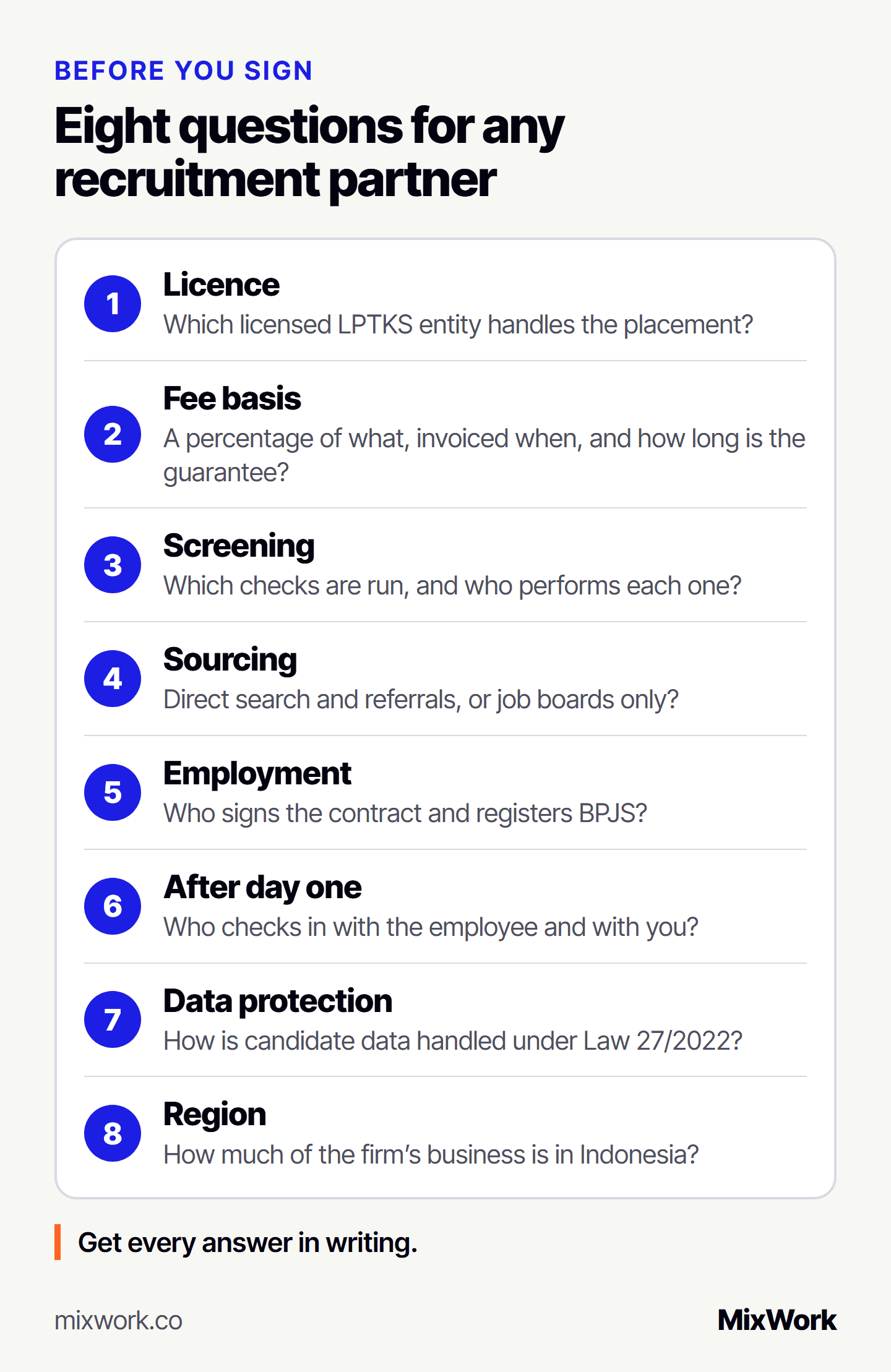
How to judge a recruitment partner in Indonesia
Ask these, in writing, before you sign.
• Licence: which licensed LPTKS entity will handle the placement.
• Fee basis: percentage of what, invoiced when, replacement guarantee period and exclusions.
• Screening steps: CV screen, English assessment method, technical or case interview, identity and document verification, professional background and reference checks, and who performs each.
• Sourcing channels: direct search and referrals, or job boards only. If the shortlist comes only from job-board responses, you could have run that search yourself.
• Employment: who signs the contract and registers BPJS, and whether the agency can do it or you must.
• After the start date: who checks in with the employee and with you, how often, and whether that is included in the fee.
• Data protection: how candidate data is handled under Law 27/2022 on Personal Data Protection, and what confidentiality terms bind the agency.
• Region: how much of the firm’s business is Indonesia, and whether its process was built for this market or configured for it.
Executive and C-suite search
If the role is a country manager, a finance director or a general manager who will sign for the business, the approach has to be discreet and senior-to-senior, and the strongest candidates are employed rather than looking. For most of those mandates, an established executive search practice is the first call; our comparison of recruitment agencies in Indonesia names several. MixWork Recruit also runs C-suite searches through a specialised team.
For how a senior search in Jakarta differs from one in the US or Europe, from notice periods and THR timing to director liability, see our guide to executive search in Jakarta.
Expect a longer close than for a mid-level hire, because notice periods at that level run 30 days or more.
How MixWork Recruit runs a search
MixWork Recruit is organised as specialised recruitment teams for IT, healthcare and medical, marketing, finance, industrial roles and C-suite search, so the people screening a finance controller are not the people screening a backend engineer.
Every search runs on proprietary data and AI tools inside MixWork’s own platform: our own data on the Indonesian professional pool and AI-assisted matching that narrows the field before a recruiter picks up the phone. That is part of why a first shortlist can arrive as fast as 24 hours; the judgement about who goes on it stays with the team.
We recruit as the front half of an employer of record engagement, so the people who choose the shortlist are the people who employ the hire and answer for how they are doing. The process below is the same for every search.
• Scoping call, 15 minutes: the role in Indonesian terms, seniority by scope and pedigree, city, and an all-in monthly cost including BPJS and THR, confirmed in a written quotation.
• Sourcing: direct search through our network of MNC-background professionals, plus the major boards; a first shortlist as fast as 24 hours for early-career and mid-level roles and 48 hours for senior and director roles.
• Screening: CV and pedigree screen, a live English conversation on a work topic, a technical or case interview by function, then identity and document verification and professional background checks before any offer goes out.
• Offer and employment: PKWTT permanent contract in Bahasa Indonesia, BPJS registration within 30 days of the start date, payroll and PPh 21 in our name, with confidentiality and data-protection terms drafted against Law 27/2022.
• After day one: MixWork Total Care 360, on EOR Professional. A named HR manager in Jakarta, backed by an HR team, monthly check-in calls with the employee and with you, engagement and dispute resolution, and performance and attendance monitoring. Optional MixWork Spaces in our own Jakarta office from USD 199 a month, MixWork Managed IT from USD 99 a month, and MixWork Flex Benefits from USD 29.
The MixWork Recruit fee is from 10% of first-year salary, payable only when a hire is confirmed. No retainer and no charge for a search that does not close. Twelve-month retention across our placements runs above 90%, measured on our own placement data, which is the number that matters more than the fee, because a hire who leaves in month nine costs more than any recruitment percentage.
We employ people only as full-time, permanent staff on compliant Indonesian contracts. We do not place contractors or freelancers, and we do not sponsor work permits for foreign nationals. If one of those is what you need, we will tell you on the first call.
Regulations referenced in this guide
• Law 13/2003 on Manpower, as amended by Law 6/2023, art. 35 to 38 on placement and placement fees.
• Ministerial Regulation (Permenaker) 39/2016 on Manpower Placement, including LPTKS licensing.
• Government Regulation 35/2021 on fixed-term contracts, outsourcing, working time and termination, including the 30-day resignation notice.
• Law 18/2017 on the Protection of Indonesian Migrant Workers, which governs P3MI agencies.
• Law 24/2011 on BPJS, requiring registration within 30 days of the start date.
• Law 27/2022 on Personal Data Protection.
This guide is general information current as at 11 September 2026; agency facts were re-checked on 3 October 2026. The Constitutional Court (Decision 168/PUU-XXI/2023) gave lawmakers until 31 October 2026 to pass a new manpower law, which may change the rules described here. It is not legal advice; confirm licensing, fee and employment questions with qualified Indonesian counsel before you rely on them.
Frequently Asked Questions
Related guides
• Employer of Record in Indonesia: the complete 2026 guide
• Cost to hire employees in Indonesia: 2026 breakdown
• How to hire employees in Indonesia, step by step
• Hire an offshore team in Southeast Asia
• Hiring in Jakarta: the talent market
• How to retain professional talent in Indonesia (2026 guide)
• 5 best recruiting books for HR teams, chosen by MixWork recruiters
• How to hire contractors in Indonesia compliantly
• Hire IT developers and software engineers in Indonesia
• Hire an executive assistant in Indonesia
• Best EOR companies in Indonesia, compared
Proof: MixWork case studies
• Case study: an AI-ready engineering team, 2 engineers placed, brief to shortlist in under 7 days
• Case study: a compliance-ready IT team for a listed group, 7 roles, hired in under 45 days
• Case study: an e-commerce rebuild for a retailer, brief to hire in under 20 days
• Case study: a four-person remote marketing pod for a DTC brand
• Case study: a five-person support and operations team for a lifestyle brand
• Case study: a managed four-person creative team for a marketing agency
• MixWork Jakarta: office, workspaces and the team on the ground
• MixWork placement data: retention, profile and hiring speed (Q3 2026)
• EOR onboarding in Indonesia: the first 14 days
• Best recruitment agencies in Indonesia for international companies (2026): eight compared