
To retain professional talent in Indonesia, hire mid-career professionals with multinational backgrounds, employ them properly, and then give them the seven things they consistently value: hybrid work with real office days, health cover above BPJS, transport and meal allowances, a company-issued device, clear instructions, a reachable HR contact, and recognition. None of these costs much against a replacement hire. A lone remote contractor on a bare salary has none of them, which is why that arrangement usually ends up the most expensive.
This guide is written for international employers and their HR teams. It covers what Indonesian professionals actually appreciate (rather than what a global benefits template assumes), what the perks cost, and the working conditions that keep a team productive and relevant as the tools of the job change. For the month-by-month operating plan, see how to build an offshore team that stays.
Where this guide comes from
This guide comes from MixWork’s own experience of recruiting, employing and supporting Indonesian professionals for international clients. We have placed more than 100 professionals in remote roles for clients across IT, fintech, healthcare, marketing, retail, e-commerce and other industries, from startups and SMEs to enterprise teams with stakeholders in several countries.
Our HR team in Jakarta holds a monthly check-in call with every professional we employ through MixWork EOR, and a separate monthly call with the manager they report to. That gives us a running view of what people value, what they put up with, and what makes them start answering recruiters. The seven things below are the ones that come up again and again. Where we cite outside research, we name the study and its date.
The market you are hiring into
Indonesia’s professional labour market is deep, competitive and, in 2026, relatively stable. Three numbers set the scene.
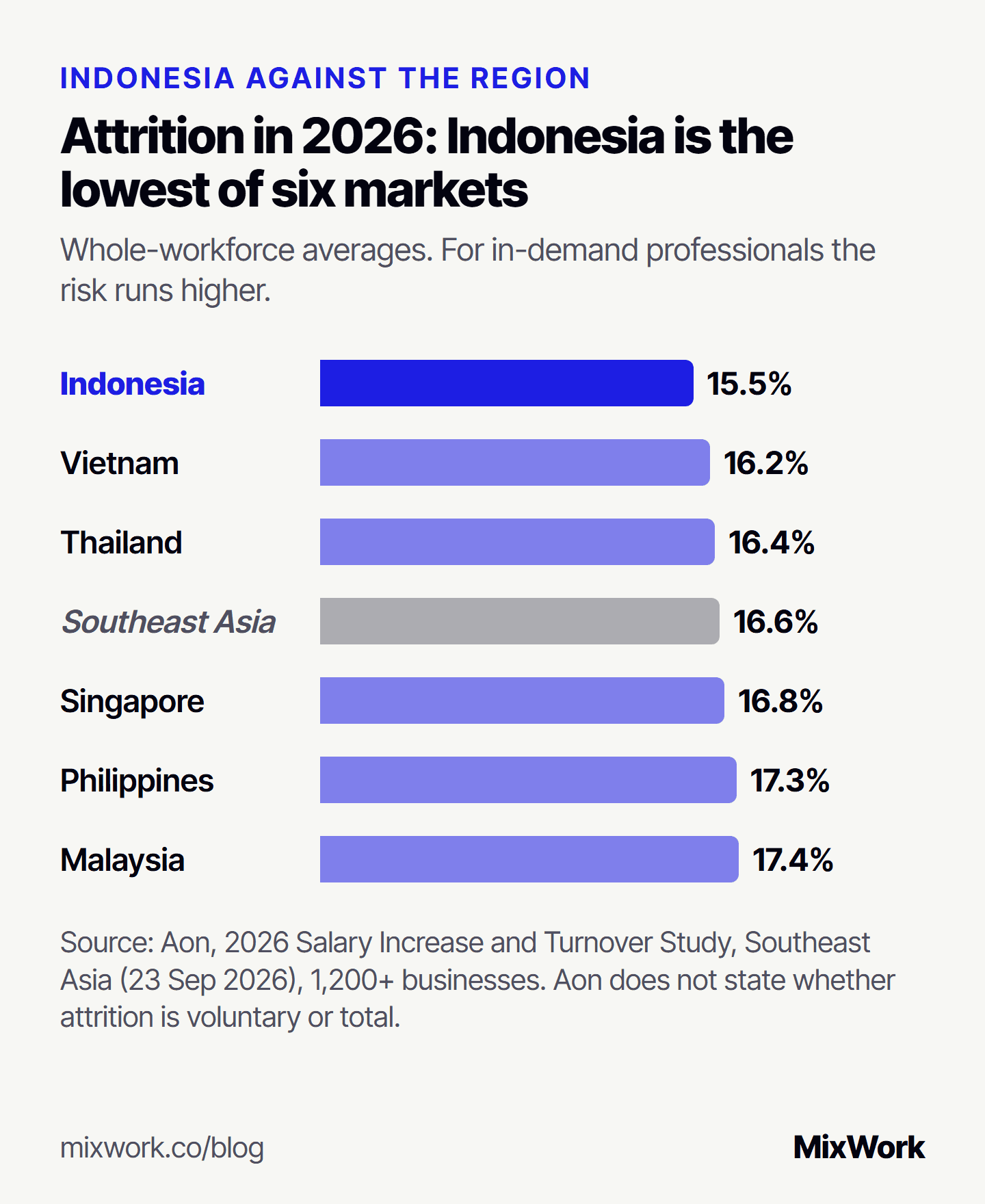
Attrition is the lowest in the region but still material. Aon’s 2026 Salary Increase and Turnover Study, released 23 September 2026 and covering more than 1,200 businesses across six Southeast Asian markets, puts Indonesian attrition at 15.5% for 2026, against a regional average of 16.6%. It was 20.8% in 2024. Aon does not say whether the figure is voluntary or total, so read it as “about one in six people leave in a year”. Read it also as a floor for the people this guide is about. It is a whole-workforce average across more than 1,200 companies, blending operational and entry-level roles with professionals, and no published Indonesian study we could find breaks attrition out by level or performance. From what we see, the pressure concentrates on exactly the cohort international employers want. High performers, especially those with multinational experience, receive a steady flow of unsolicited offers from recruiters while they are employed and not looking, and they are the people a counter-offer is written for. Plan on their turnover risk being higher than the headline, not lower. Salary budgets in Indonesia rose 5.4% in 2026, with 5.5% budgeted for 2027, above Aon’s regional projection of 5.2%.
Engagement is above the regional and global averages. Gallup’s State of the Global Workplace 2026 report puts Indonesian employee engagement at 27%, against 25% for Southeast Asia and 20% globally. Daily stress is low at 14%. The weaker numbers are wellbeing: 30% of Indonesian employees are thriving in their overall lives, below the regional 36%, and daily loneliness at 23% is above the regional 19%. Those two figures matter for remote teams in particular.
Pay is seen as fair, and that is not the same as satisfying. Jobstreet by SEEK’s Salary Pulse 2026, an online survey of 1,010 Indonesian professionals fielded in February 2026, found 81% said their pay was fair for the work they do, while 66% were satisfied with the amount. Asked what they would do if refused a raise, 28% said they would prefer non-salary benefits such as performance bonuses, health insurance and welfare allowances instead. Employees who received performance-based raises were far more satisfied (89%) than those who received across-the-board adjustments (67%). (Figures from press coverage of the report, June 2026.)
So the people are there and engaged, and they will still move for a better offer if the one they have is merely fair.
Retention starts with who you hire
Retention in Indonesia is mostly decided before the first interview, in the profile you set out to hire, the channels you use and how you screen. Four decisions do most of the work.
Decide the composition before you post a role. The highest-value band is mid-career, around six years in: past the training phase, before the management overhead, still doing the work themselves. In Jakarta that cohort has typically spent those years inside multinationals and global agencies, which means international-standard process and English used daily with clients and stakeholders. Early-career professionals two to five years in, often from the same employers, are the next band. Six years inside a multinational costs a fraction in Jakarta of what the same profile costs in Singapore or Sydney. Our guide to the Jakarta talent market covers where that pool comes from.
Use the channels that reach that cohort. LinkedIn, Jobstreet and Glints are the three boards that matter for professional roles, with Kalibrr for tech; our ranking of Indonesian job boards compares reach, candidate quality and posting costs. Referrals from people already on the team are the cleanest channel of all and the best engagement survey you will get.
Screen for the role, not for a score. Test English in a live conversation on a work topic plus a written exercise, not with a national proficiency statistic. Run a case or technical interview by function. Verify identity and documents and run background checks before any offer goes out. On MixWork’s own searches a first shortlist arrives as fast as 24 hours for early-career and mid-level roles and 48 hours for senior and director roles, recruitment typically takes two to three weeks to an accepted offer, and the 30-day notice period most employed candidates serve sets the real start date.
Expect a counter-offer. The professionals worth hiring are already employed, and Indonesian employers counter. Plan the offer on total package, not base alone. Only THR, the thirteenth month, is mandated, but high performers sometimes negotiate a fixed annual bonus into their contract, so ask what the current package contains before you price yours: the allowances, the insurance and the device are read as signals of how the employer treats people, and they are exactly where a counter-offer is weakest.
How to retain professional talent in Indonesia: the seven things they value
The professionals we place consistently value seven things: hybrid work with real office days, health cover above BPJS, transport and meal allowances, a company-issued device, clear instructions, HR support they can reach, and recognition. The first six are what we see across our own placements; the seventh is what the 2026 surveys add.
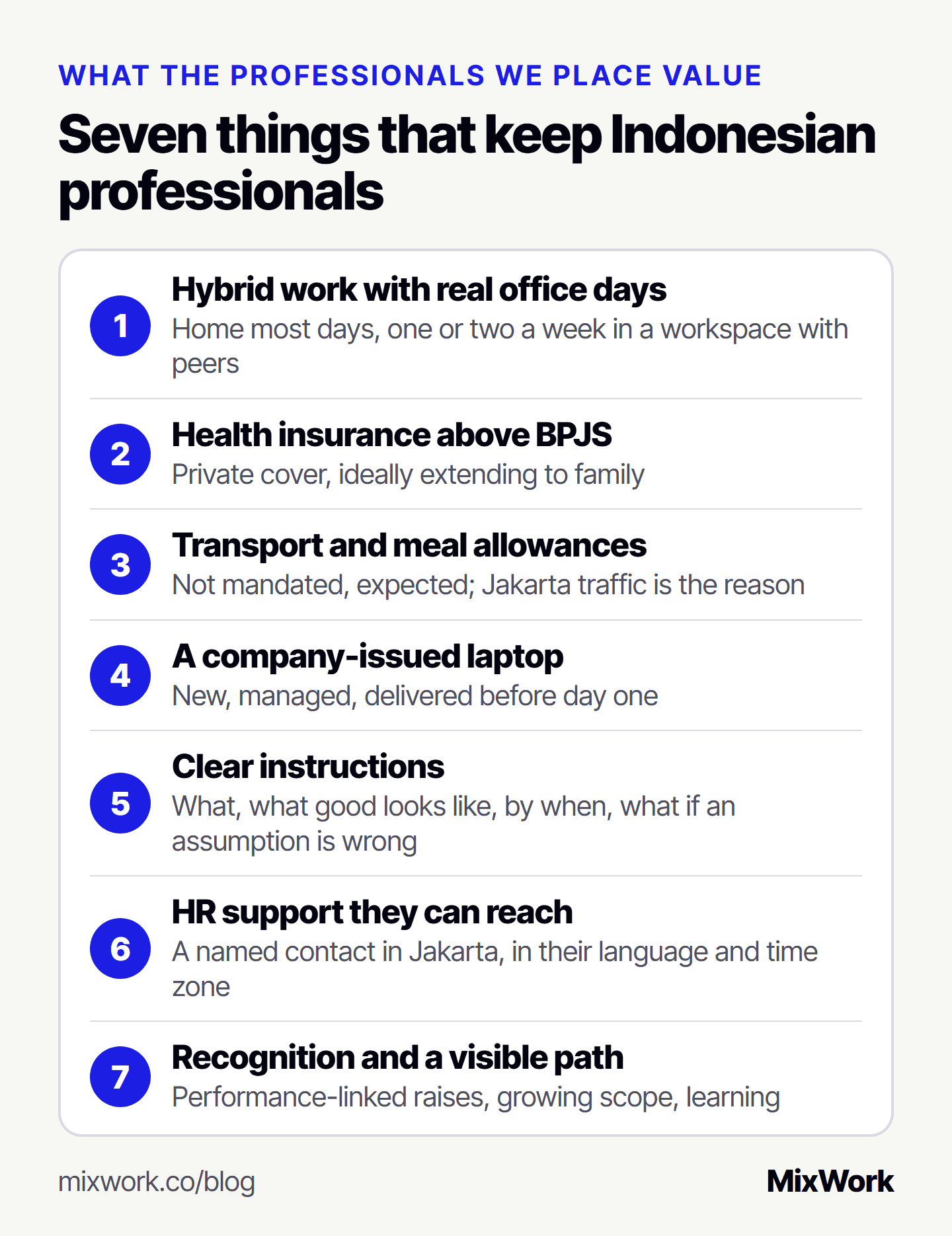
1. Hybrid work, with real office days. The professionals we place like working from home, and they also value coming into the office for the camaraderie and the collaborative work, which in practice means one or two days a week rather than five. The two are not in tension. Jakarta’s traffic makes a five-day office a real cost: in TomTom’s Traffic Index for 2025 a 10 km drive averaged 26 minutes 19 seconds, rising to 38 minutes 43 seconds in the evening rush hour, and a rush-hour commuter lost 125 hours to congestion over the year. Full-time home working carries the other cost. Gallup’s loneliness figure for Indonesia (23% experienced it a lot of the previous day, above the regional 19%) is the quiet reason remote hires drift. The pattern that holds is one or two anchor days a week in a professional workspace, alongside other professionals working for international clients, with the rest of the week at home. We go through the field evidence in our comparison of home offices and dedicated workspaces.
2. Health insurance and benefits above the statutory floor. BPJS Kesehatan is the national health scheme and every compliant employer enrols staff in it. Professionals who have worked in multinationals have usually had private cover on top, often extending to family, and they notice its absence immediately. Medical inflation sharpens the point: Mercer Marsh Benefits’ Health Trends 2026 report projects Indonesia’s medical cost trend at 17.6% for 2026, 5.2 points above the Asia average of 12.5%, so private cover is worth more to the employee every year. Dental and optical, a wellness or mental-health allowance and a fitness plan follow in roughly that order. In Jobstreet’s 2026 data, health insurance sits alongside performance bonuses and welfare allowances as the non-salary benefits people would take instead of a raise.
3. Transport and meal allowances. These are a must, not a perk. The commute above is the reason. A monthly transport allowance (tunjangan transportasi) and a meal allowance (tunjangan makan) are standard in Indonesian professional employment, and a package without them reads as an employer that has not understood the market. They are felt in every pay cycle rather than once a year at review time. One structural point to settle with counsel: whether an allowance is fixed or tied to attendance affects which wage components it falls into under Government Regulation 36/2021, and therefore the base for THR and BPJS.
4. A company-issued device. The professionals we place like a new device, and they do not like using their own laptop for work unless they are reimbursed for it. A company-issued, managed laptop does three things at once: it removes a cost the employee would otherwise carry, it signals that the employer invests in them, and it puts the device under your security policy rather than the household’s. Our guide to device security for remote teams sets out why that last point is not optional once client data is involved. Deliver it before day one, procured locally so it does not sit in customs.
5. Clear instructions. The professionals we place work best from a clear brief: what the work is, what good looks like, by when, and what to do if an assumption turns out wrong. Vague briefs do not produce questions; they produce a polite yes and a quiet workaround. We give our clients’ managers the Playback Rule from our guide to managing an offshore team in Indonesia: never close a briefing on a “yes”, close it on the other person restating in their own words what they will do. Clarity is also the cheapest productivity lever you have.
6. HR support they can actually reach. A named HR contact in Jakarta, in their language and time zone, who can answer a question about pay, leave, BPJS, a family emergency or a disagreement with the manager abroad. Without one, problems go to the line manager overseas, or nowhere, until the resignation. In our check-ins it is the most common gap in arrangements that pay people correctly and still lose them.
7. Recognition and a visible path. Jobstreet’s commentary on its Salary Pulse 2026, as reported in June 2026, reads the gap between “fair” (81%) and “satisfied” (66%) as a demand for greater appreciation of the contribution people make. In practice that is performance-linked raises rather than across-the-board ones, a title and scope that grow, learning that keeps skills current, and the first team lead promoted from within. PwC’s Hopes and Fears 2025 data for Indonesia, released February 2026, found 64% of non-managers said they had access to learning resources against 89% of senior executives; the gap is where ambitious people start looking. Professional development is part of how we close it: every new hire on our Indonesian team completes the MixWork Certified Remote Professional course through MixWork Academy, eight short video modules on the habits international teams hire for, with a quiz after each and a verified badge they can show on LinkedIn.
The statutory floor, and what sits above it
The law sets a floor. Every compliant employer in Indonesia provides it, which means it wins you nothing competitively; it keeps you legal. The table separates what is mandatory from what professionals expect and what actually moves retention.
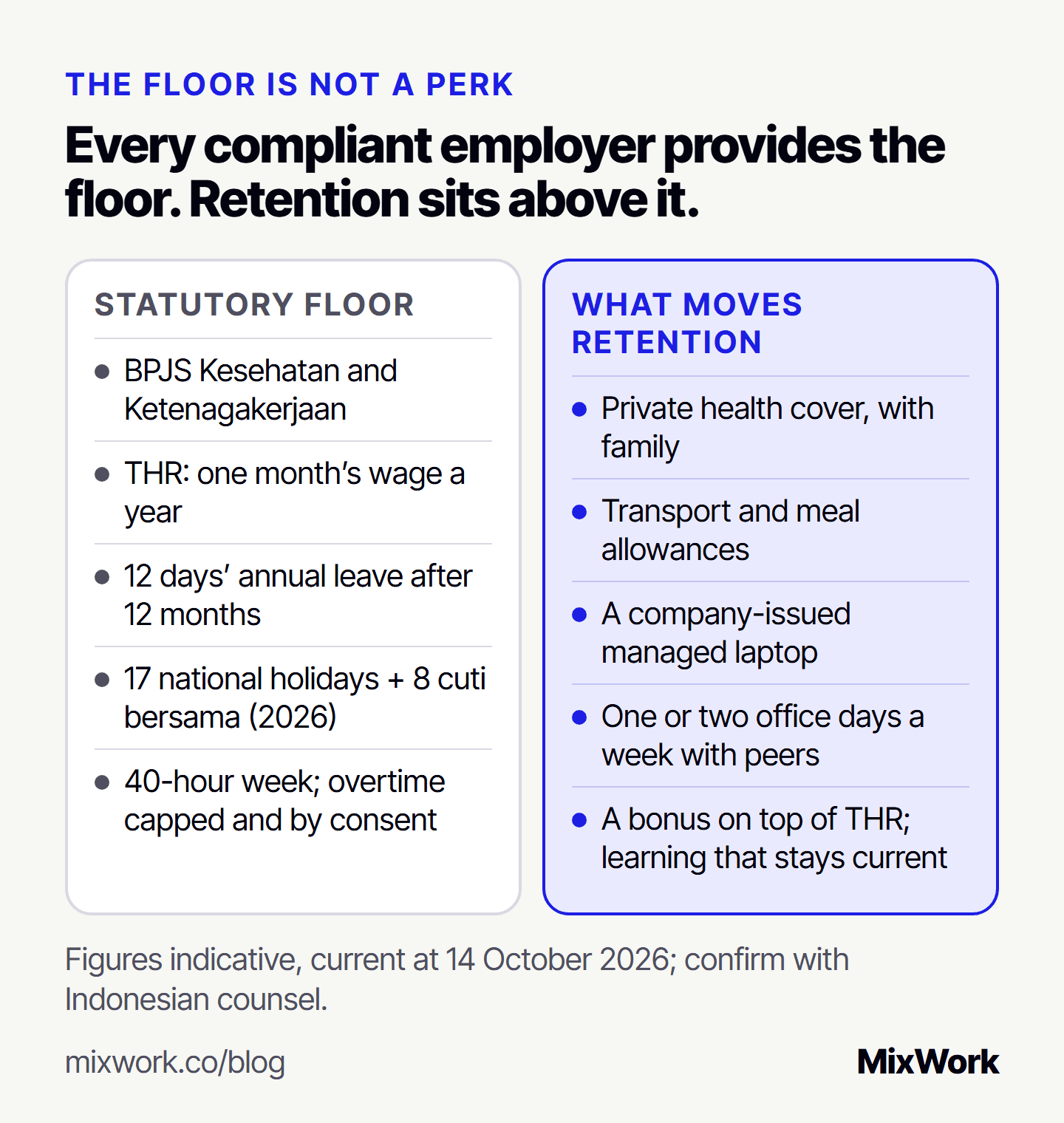
Area | Statutory floor (Indonesia, 2026) | What professionals expect | What moves retention |
|---|---|---|---|
Health cover | BPJS Kesehatan: employer 4%, employee 1%, capped on IDR 12,000,000 a month | Private medical insurance on top | Cover that extends to family; dental and optical |
Social security | BPJS Ketenagakerjaan: JHT 3.7%, JP 2%, JKK 0.24% to 1.74%, JKM 0.3% (employer side) | Correct enrolment from month one | Nothing extra; it is noticed only when wrong |
Religious holiday allowance | THR: one month’s wage after 12 months’ service, prorated below, paid at least seven days before the holiday | THR on time, every year | A bonus on top. No bonus beyond THR is mandated, but high performers sometimes negotiate a fixed annual bonus into their contract; for everyone else a performance bonus against agreed results |
Leave | 12 working days after 12 months (Manpower Law art. 79 as amended); 17 national holidays and 8 cuti bersama in 2026 | Cuti bersama not deducted from the 12 days | Additional leave days; flexibility around Lebaran |
Maternity leave | Three months (Manpower Law art. 82); Law 4/2024 (UU KIA) adds up to three further months on a doctor’s certificate in defined medical cases | The statutory entitlement honoured without friction | Flexible return-to-work arrangements |
Working hours | 40 hours a week; overtime capped at 4 hours a day and 18 a week with consent (PP 35/2021 art. 26) | Steady hours; overtime agreed, not assumed | Agreed overlap window with the overseas team, protected focus time |
Allowances | None mandated beyond wage | Transport and meal allowances every month | Allowances set at a level that reflects the Jakarta commute |
Equipment | None mandated | A company laptop, or reimbursement for their own | A new, managed device delivered before day one |
Workplace | None mandated | The option of an office, not a five-day obligation | One or two anchor days a week with peers; home the rest |
Figures are current as at 14 October 2026 and indicative. BPJS rates and caps are set out in our BPJS employer cost guide and THR in our THR guide. Whether cuti bersama reduces annual leave is a matter of company policy and the applicable ministerial guidance, and how the UU KIA extension and its pay terms apply in practice should be checked against the current implementing rules. Confirm all of it with Indonesian counsel before it goes into a contract.
The perks that work, and what they cost
Private health cover, the two allowances and a company laptop are the perks that work hardest. The table ranks all eight by how often they come up in our monthly check-ins and how hard they are for a counter-offer to match.
Perk | Why it works | Hard to match? | Indicative cost |
|---|---|---|---|
Private health insurance, with family cover | Noticed first, valued longest; medical inflation of 17.6% makes it worth more each year, and a counter-offer is usually base salary | Hard | Flex Benefits from USD 29 per employee a month; family cover depends on the mix chosen |
Transport and meal allowances | Felt every pay cycle; reads as respect for the commute; easy to match, costly to omit | Easy | Set by role and location; paid through payroll as monthly lines |
Company-issued managed laptop | Removes a personal cost; signals investment; secures client data; many employers still run bring-your-own | Moderate | Managed IT from USD 99 per device a month, no upfront |
A desk in a professional workspace, one or two days a week | Camaraderie, collaboration, and a daily reason to stay; needs a real office with other professionals in it | Hard | Spaces from USD 199 per workspace a month |
Performance-linked raise or bonus | 89% satisfaction versus 67% for across-the-board adjustments (Jobstreet, 2026); high performers sometimes negotiate a fixed annual bonus into the contract | Moderate | Set against agreed outcomes, or fixed in the contract; sits on top of THR, which is the only mandated extra month |
Learning sessions on current tools | Skills stay current; the ambitious stay to learn; hard to sustain alone | Hard | Time, mostly; included in Total Care 360 |
Team activities with other remote professionals | Counters the loneliness figure; builds relationships beyond the manager; a single-hire employer cannot provide it | Hard | Low; needs a group to belong to |
Wellness and mental-health allowance | Valued most once needed; burnout surfaces as a resignation | Moderate | Part of a flexible benefits budget |
A note on the two cheapest items. Learning sessions and team activities cost almost nothing and are the hardest for a single-hire employer to deliver, because one person working alone from a Jakarta apartment has nobody to learn with or belong to. That is the structural reason retention is easier inside a managed team than with a lone remote hire, and it is the reason we run both as standard.
How to future-proof the team: productivity and AI fluency
A team stays productive, and stays relevant as the tools of the job change, through conditions rather than pressure. Five of them do most of the work.
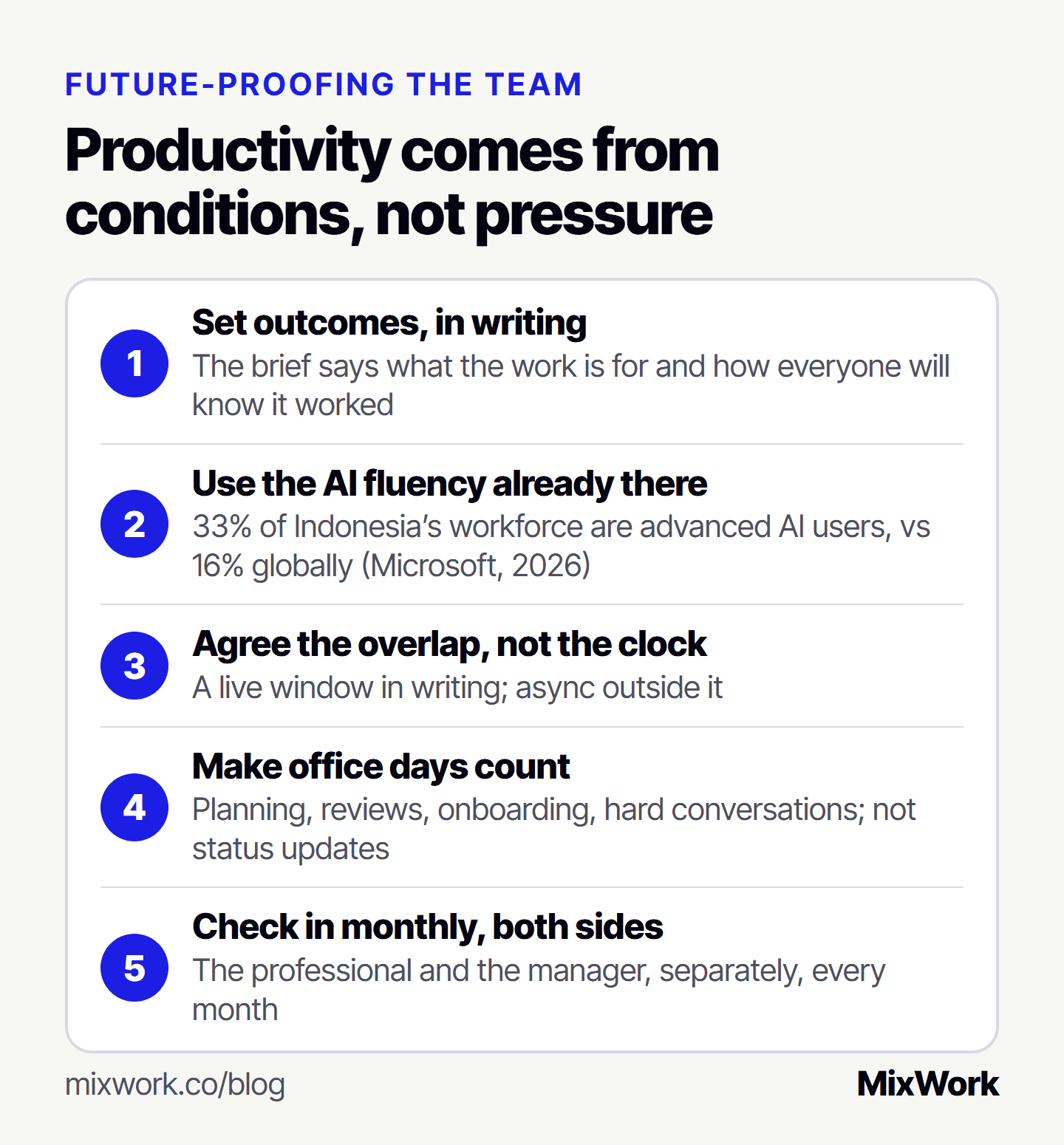
Set outcomes, and write them down. The brief says what the work is for and how everyone will know it worked. Updates are written against that line. Our clients increasingly judge remote professionals on measurable improvements rather than activity, and the professionals who progress can point to what their work changed. Our guide to performance management for remote teams covers the cadence.
Use the AI fluency that is already there. Microsoft’s Work Trend Index 2026, published 30 June 2026, found 33% of Indonesia’s workforce are “Frontier Professionals”, its term for advanced AI users, more than double the 16% global average; 93% of Indonesian AI users treat AI output as a starting point rather than a final answer, against 86% globally; and 62% rank critical thinking as the top skill for the AI era, against 46% globally. PwC’s Indonesia data, released February 2026, found 96% of daily generative AI users reported higher productivity. Every professional MixWork places works with AI tools daily as standard, and we run regular learning sessions on the tools each role uses and on using them without switching off their own judgement. An employer that blocks the tools, or says nothing about them, wastes that head start.
Agree the overlap, not the clock. From Jakarta the overlap with Singapore is most of the day, with Sydney five to six hours, with Europe the Jakarta afternoon, and with the United States a handover model. Fix the live window in writing, work in writing outside it, and hold both sides to it. Late-night replies are a signal of a broken window, not of commitment.
Make the office days count. If people are commuting through Jakarta traffic to come in, the day should be for the things that need a room: planning, reviews, onboarding a new colleague, the difficult conversation. Status updates do not need a room.
Check in monthly, on both sides. A structured call with the professional and a separate one with their manager, every month, surfaces disengagement months before the exit interview would. It is also where the allowance that is too low, the laptop that is too old and the brief that was never clear get said out loud. The manager’s side of this is set out in our guide to managing an offshore team in Indonesia; the employee’s side in how to be a successful remote worker.
Indonesia against the region
Indonesia has the lowest attrition of the six Southeast Asian markets Aon surveyed and above-average engagement; it trails the region on wellbeing. The comparison is worth making honestly, because Indonesia does not win every line.
Market | Attrition 2024 | Attrition 2026 |
|---|---|---|
Indonesia | 20.8% | 15.5% |
Vietnam | 15.5% | 16.2% |
Thailand | 16.6% | 16.4% |
Singapore | 16.7% | 16.8% |
Philippines | 19.1% | 17.3% |
Malaysia | 15.9% | 17.4% |
Southeast Asia | 17.4% | 16.6% |
Source: Aon, 2026 Salary Increase and Turnover Study, Southeast Asia, released 23 September 2026, more than 1,200 businesses; Aon does not state whether attrition is voluntary or total. Accessed 14 October 2026.
Indonesia’s attrition fell from 20.8% in 2024 to 15.5% in 2026 while salary budgets rose 5.4%, above Aon’s 5.2% regional projection for 2027. That is the combination you want: a market that is stable to employ in and competitive enough that employers invest in their people. On engagement, Gallup’s State of the Global Workplace 2026 puts Indonesia at 27% against a regional 25%; the Philippines leads the region at 39% on Gallup’s country page, and its BPO sector is built for native-accent voice support at volume, which is a different market from the professional roles this guide is about. Where Indonesia is weaker is wellbeing: the thriving and loneliness figures above are the case for a real workplace and a real HR presence, not a reason to hire elsewhere.
Five ways employers lose Indonesian professionals
A raise that arrives after the resignation. By the time the counter-offer is made, the person has already decided. Performance-linked raises on a known cycle beat a scramble in month nine.
”Bring your own laptop.” It costs the employee money, it tells them what the employer thinks they are worth, and it puts client data on a household machine.
A full-remote hire with nobody to belong to. Gallup’s loneliness figure is the leading indicator. The remedy is a workspace with peers and team activities, not a Friday video call.
Treating the team as a vendor. No one-to-ones, no inclusion in decisions, no feedback cycle. People who are managed like a vendor behave like one, and vendors change clients.
Getting the statutory basics wrong. Late THR, a missed BPJS registration, an allowance that quietly disappears. None of these is forgiven. THR dates and BPJS enrolment are common knowledge, and a missed one is noticed in the first pay cycle.
Where MixWork fits
MixWork is Indonesia’s leading Employer of Record and professional recruitment platform. MixWork Recruit finds the professionals: specialised teams for IT, healthcare and medical, marketing, finance, industrial roles and C-suite search, running on our own platform and data, with a first shortlist as fast as 24 hours. More than 80% of the people we place come from multinational or global-agency backgrounds.
MixWork EOR then employs them on permanent, compliant Indonesian contracts and runs payroll, PPh 21, BPJS and THR. Total Care 360 is included at no extra cost: a named HR manager in Jakarta backed by a full HR team, monthly check-in calls with the employee and with you, engagement and dispute resolution, and performance and attendance monitoring, plus the professional learning sessions and team activities described above, and the MixWork Academy certification every new hire on our Indonesian team completes. The three things on the perks table that a single employer struggles to deliver sit under the same agreement: a desk at MixWork Spaces in our own Jakarta office, a managed laptop through MixWork Managed IT, and private cover through MixWork Flex Benefits, with the transport and meal allowances paid through payroll under the same EOR agreement. Current rates are on the pricing page.
We put the retention our clients see down to a people-first culture: a permanent, fully compliant job working for an international client, with MixWork as the employer of record, benefits above the statutory floor, hands-on HR support and a career that keeps moving. Twelve-month retention across our placements runs above 90%, measured on our own placement data.
Disclaimer. This guide is general information, current as at 14 October 2026, and is not legal advice. Statutory figures (BPJS rates and caps, THR, leave, parental leave, working hours) are indicative, change by regulation, and a new standalone manpower law is due before the Constitutional Court’s 31 October 2026 deadline. Confirm every figure with qualified Indonesian legal counsel before relying on it. MixWork provides recruitment, EOR and HR services and does not provide legal advice.