
To be a successful remote worker on an international team, make your work easy for a manager in another country to see and act on. Then build, on purpose, the working relationships that distance takes away. In practice that comes down to eight habits:
Keep a status note your manager can read without asking.
Report outcomes, not activity.
Ask which deadline comes first when you have too many.
Write messages people can act on without replying.
Close every day with a short handover note.
Replace meetings with written decisions.
Set up your workspace like a professional.
Keep steady hours instead of working late.
This guide is written for Indonesian professionals working for a company in Singapore, Australia or the United States, and it applies to anyone whose manager sits in another country. Employers have their own half of the same standard, in the employer’s guide to professional remote work.
Where this guide comes from
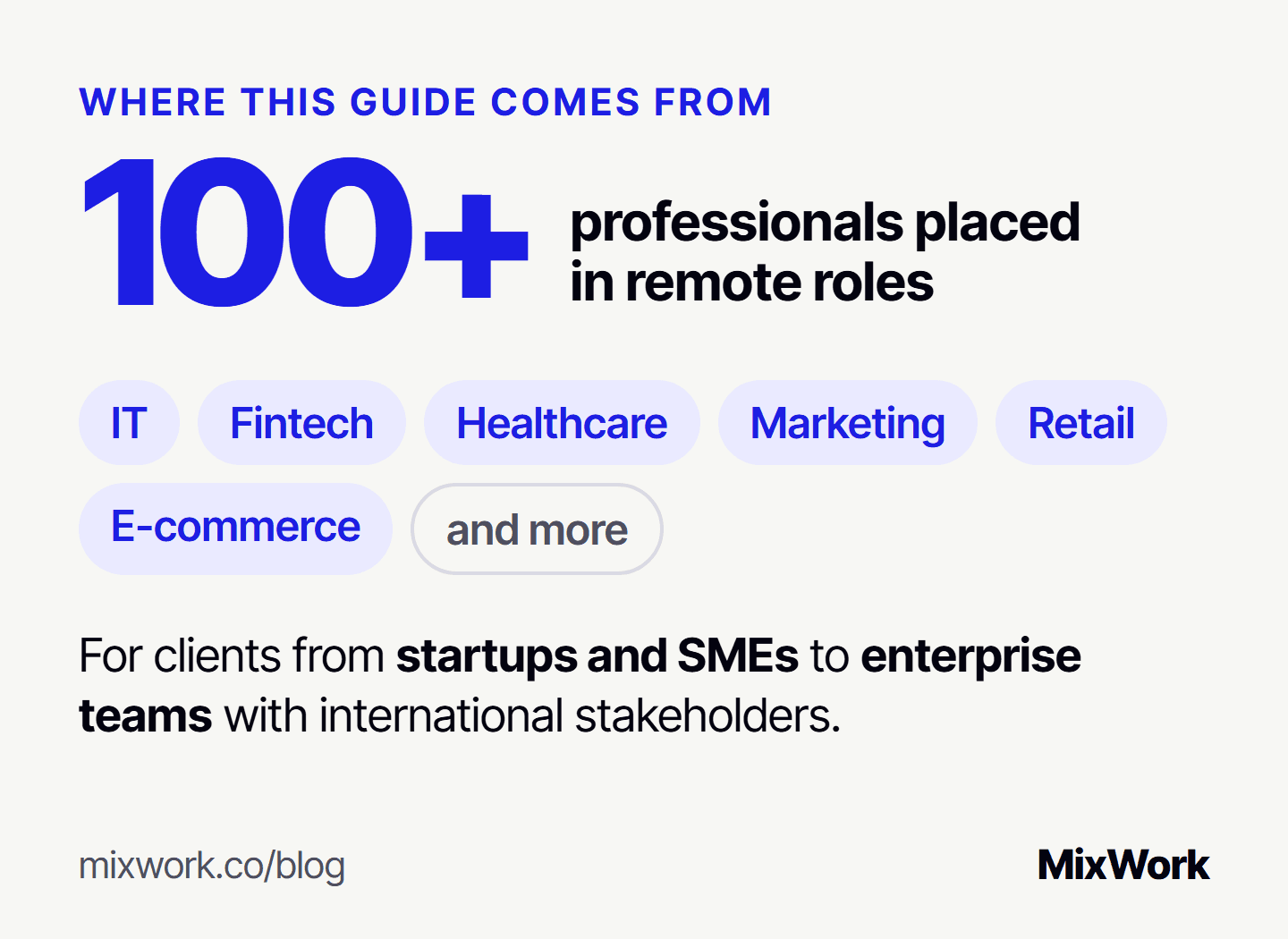
This guide comes from MixWork’s own experience of placing and supporting remote professionals. We have placed more than 100 professionals in remote roles for clients across IT, fintech, healthcare, marketing, retail, e-commerce and other industries. Our clients range from startups and SMEs to enterprise teams with stakeholders in several countries. Where we cite outside research, we name the study and its date.
Our HR team stays in regular contact with the professionals we place and with the managers they report to, so we see both sides of every remote working relationship. The habits in this guide are the ones we have seen separate the professionals whose careers move forward from those who stall, whatever the industry or the size of the client.
Two gaps come up more than any others. Most new hires have not yet learned the detailed written communication that async work depends on, where a message has to stand on its own without a conversation around it. And many are reluctant to ask questions, so they spend hours working around something a one-line question would have settled. Both can be learned once someone names them.
We also see a clear shift in what clients expect. Teams increasingly prioritise measurable outcomes, and they judge remote professionals on the results and improvements they can show. Quietly completing a defined scope of work in the background no longer stands out. The professionals who progress can point to what their work has changed.
Why good remote workers get overlooked
Good remote workers get overlooked because their manager cannot see their effort from another country, and because distance weakens the relationships that careers depend on.
Gallup’s data shows both risks. In its State of the Global Workplace 2025 data, fully remote employees were the most engaged group at work: 31%, against 23% for hybrid employees, 23% for on-site employees in remote-capable roles and 19% for on-site employees whose roles cannot be done remotely. Yet fully remote employees were less likely to be thriving in life overall than their hybrid and on-site remote-capable colleagues, at 36% against 42%. And 57% of them were actively looking or passively watching for a new job (Gallup, The Remote Work Paradox, 7 May 2025). Gallup’s State of the Global Workplace 2026 report, covering 2025, adds that job market optimism fell five points among fully remote workers during the year. US figures look different. In Gallup’s May 2026 data on US remote-capable employees, 37% of exclusively remote employees were engaged and 52% were thriving, against 29% and 49% for on-site colleagues (Gallup, Global Indicator: Hybrid Work). Hybrid employees still thrived slightly more, at 54%. Remote work itself is not the problem for engagement. What distance takes away is connection to colleagues and visibility to the people who decide on pay and promotion, and both can be rebuilt with habits.
Start with visibility. From another country, your manager sees three things: the status you keep, the messages you send and the work you deliver. In an office they would also see you arrive, hear you handle a difficult call and notice the late night. We give the clients who manage our placements a list of eight early signals that a remote team is struggling, and every one of those signals matches a habit on the employee’s side.
The Arrival Rule: on a remote team you are judged by what arrives, not by what you did. Anything you want credit for has to arrive somewhere your manager can see it, in a form they can act on, before they have to ask for it.
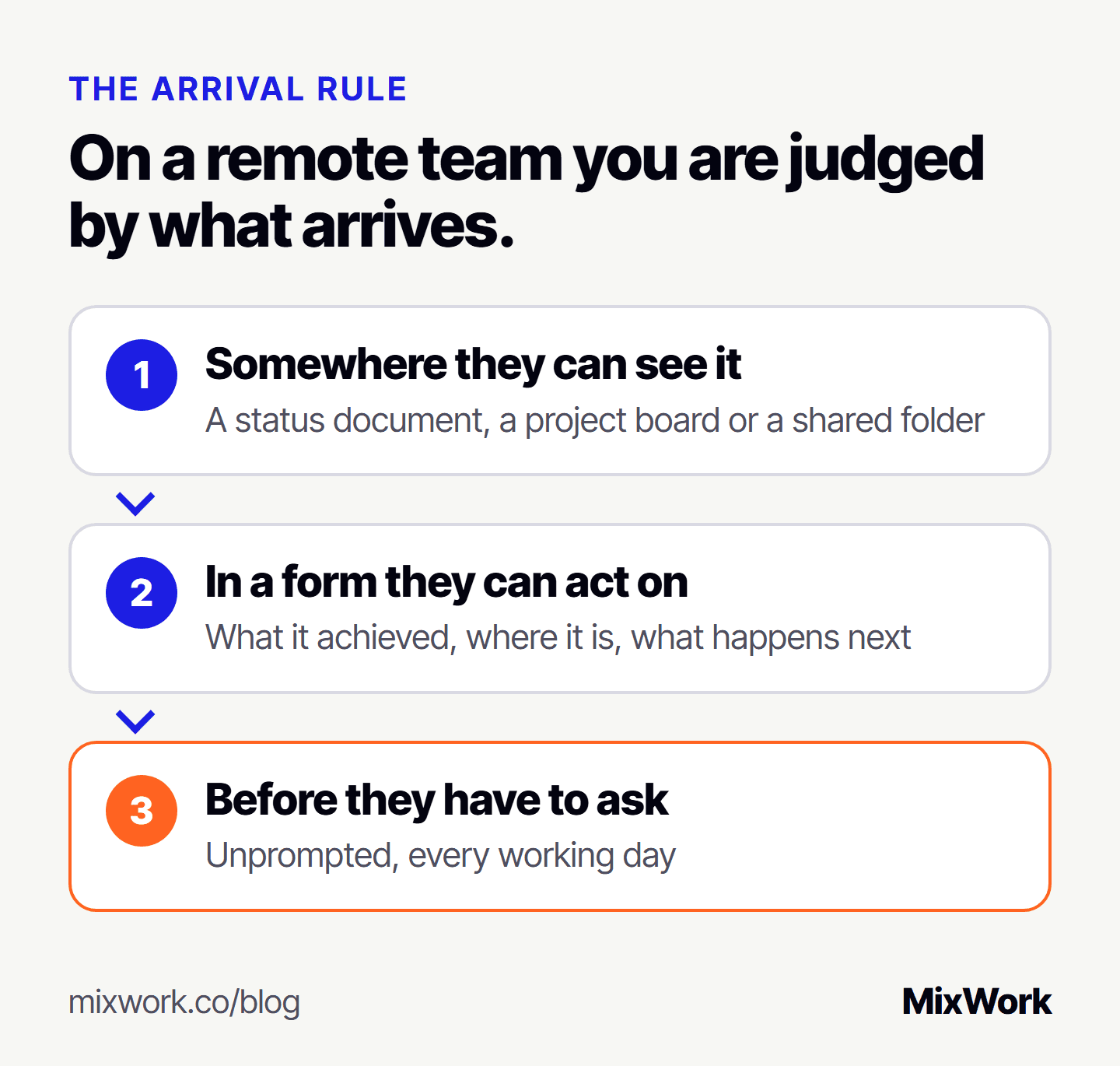
Somewhere they can see it. If work stays in your head, your local folder or a private call, nobody else can see it. Give it a place: a status document, a project board or a shared folder with a predictable structure.
In a form they can act on. “The deck is done” reports activity. “The deck is done, it is built to lift trial sign-ups as we agreed, and it is in the shared folder for your review by Thursday” can be acted on without a single question.
Before they have to ask. Once a manager has to send “where are we on this?”, the work starts to look unmanaged, whatever its quality.
Gallup found that in 2025 only 54% of US managers who supervise remote workers strongly agreed they trust their team to be productive, and 57% of employees said they feel trusted. Gallup names four practices that together can raise trust by nearly 30 percentage points, and one is clear accountability for performance expectations (Gallup, Hybrid Work and Productivity: What the Data Show, updated 28 September 2026). Agreed results, reported on a schedule, give that trust something to rest on.
The eight habits of a successful remote worker
Each habit below answers one of the signals a remote manager watches for.
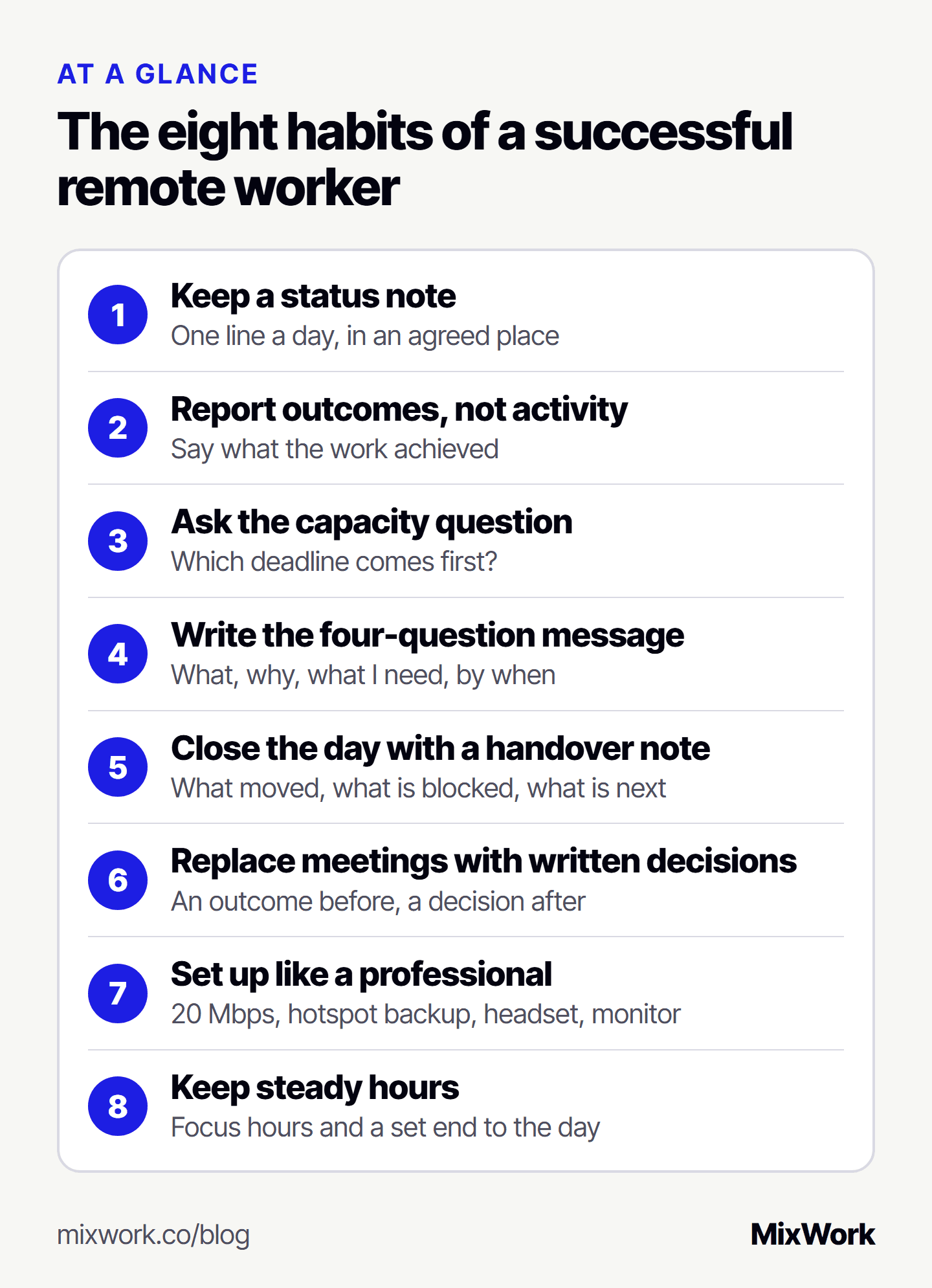
What your manager notices | The habit | What it looks like |
|---|---|---|
They have to chase you for updates | Keep a status note | One line a day, in an agreed place and format |
Tasks reported as finished with no link to the result | Report outcomes, not activity | Success criteria at the top of the document, with every update written against them |
Three deadlines accepted, no priority asked for | Ask the capacity question | “I can do two of these properly by Friday. Which comes first?” |
Messages that need a reply before anyone can act | Write the four-question message | What, why, what I need from you, by when |
The end-of-day note stops arriving | Close the day with a handover note | What moved, what is blocked, what happens next |
Meetings multiply and notes do not | Replace meetings with written decisions | A stated outcome before, a written decision after, or no meeting |
Camera off, audio echoing, calls from a moving vehicle | Set up like a professional | At least 20 Mbps with a hotspot backup, an external monitor, a headset, a webcam at eye level facing the light |
Late-night activity and weekend replies | Keep steady hours | Protected focus hours, a set end to the day, rest treated as part of the job |
1. Keep a status note. Agree with your manager where it lives, then keep it current every working day. A line saying what you are on, what is done and what is waiting on someone else replaces the check-in call, and your manager can read it when their day starts instead of waiting for yours.
2. Report outcomes, not activity. Before you start a piece of work, write at the top of the document what it is for and how everyone will know it worked. Then write each update against that line. This habit matters more every year, because the teams we work with increasingly measure remote professionals by the improvements they deliver: a process made faster, an error rate brought down, a backlog cleared.
3. Ask the capacity question. Taking on everything usually ends in three rushed deliverables or a late night. Asking which deadline comes first shows judgement and gives the priority decision to the person who sets priorities. If you cannot do something properly in the time, say so. A clear “not by Friday, but Monday” costs far less trust than a polite yes that becomes a missed deadline.
4. Write the four-question message. Every request should say what the work is, why it matters, what you need from the reader and by when. Add one line on what you will do if no reply arrives, and you avoid most of the follow-up messages that slow work down across time zones.
Example message: Please review the volume-discount slide in the Q4 pricing deck before Thursday’s client call. The client has asked about discounts twice, so the slide needs to answer the question directly. I need your approval or edits by 5 pm Singapore time on Wednesday. If I have not heard from you by then, I will send the current version and raise the open point on the call.
5. Close the day with a handover note. The status note is the line your manager can check at any time. The handover note tells them what changed today: what moved, what is blocked and what happens next. It lets a manager in another time zone stop thinking about your work overnight, and it builds a record of what you delivered. When the note turns into a list of hours worked, or stops arriving, the work has usually drifted into calls and chats where nothing is recorded.
Example handover note: Done: client FAQ updated and live; invoice batch sent to finance. In progress: onboarding guide, two sections left, on track for Thursday. Blocked: CRM export, still waiting for admin access from Daniel; I followed up at 2 pm. Tomorrow: finish the guide and prepare notes for Wednesday’s call.
6. Replace meetings with written decisions. If a meeting has no stated outcome beforehand and no written decision afterwards, propose the message that could replace it. When a meeting is needed, send the agenda in advance and the decision within the hour. Atlassian’s State of Teams 2025 survey, from the company that makes Confluence and Loom, covered 12,000 knowledge workers in six countries. More than half (56%) said they often find the only way to get the information they need is to ask someone or schedule a meeting. Across time zones that wait can cost a day, so put decisions, links and answers in the shared place your team uses, and when someone asks you the same question twice, add the answer there.
7. Set up like a professional. Our baseline for anyone working from home is:
a connection of at least 20 Mbps, with a mobile hotspot as backup
an external monitor
a headset with a microphone
a webcam at eye level, facing the light
a quiet, neutral background
Your team will notice a dropped call or an echo even if nobody mentions it. If your home cannot meet the baseline, ask your employer about a desk in a managed workspace. Our comparison of home offices and dedicated workspaces sets out the productivity evidence.
8. Keep steady hours. Microsoft’s Work Trend Index special report of 17 June 2025, built on aggregated Microsoft 365 productivity signals, shows what an unmanaged workday looks like. Meetings after 8 pm were up 16% year over year, and by 10 pm, 29% of active workers were back in their inboxes. The average worker received 117 emails and 153 Teams messages a weekday. A good manager reads a run of late-night activity as a capacity problem and raises it early. Protect your focus hours, end the day at a set time, and treat rest as part of the job.
How to communicate well in a remote team: etiquette and formats
Communicating well in a remote team means sending high-context messages in the right format. Give the reader everything they need to understand and act, because a colleague in another time zone may not be online to ask a follow-up question. Keep your sentences short and plain, since many colleagues read on a phone and some in their second language, but never leave out the context.
A high-context message carries the background in a line or two, links to the document, ticket or file instead of “the doc we discussed”, a screenshot of what you are seeing, what you have already tried, and the decision or help you need.
Low context: Hi, can we talk about the report?
High context: The October sales report shows Jakarta leads down 40% from September (screenshot attached). I checked the CRM filters and they are correct, so I think the landing-page form stopped working on 3 October. Did marketing change the page that day? I need to know by Thursday to fix it before the monthly review.
Writing is the default. Choose the format that saves the reader the most time.
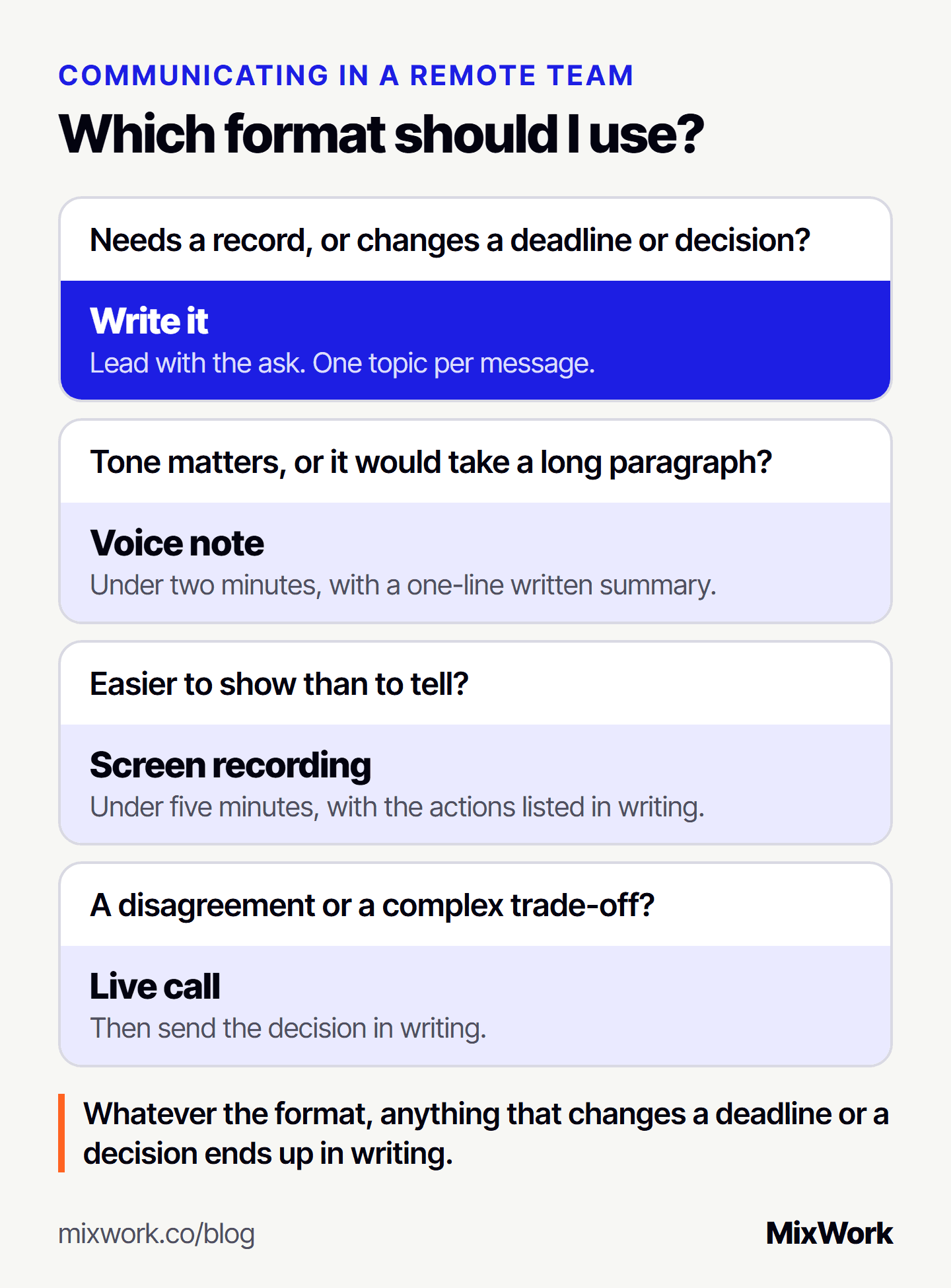
Format | Best for | How to make it work |
|---|---|---|
Written message | Requests, decisions, status updates, anything that needs a record | Lead with the ask, use the four-question format, one topic per message |
Voice note | Tone and nuance, or a quick explanation that would take a long paragraph to write | Keep it under two minutes, add a one-line written summary, and never let it be the only record of a decision or deadline |
Short screen recording, such as a Loom video | Walkthroughs, bug reports, feedback on a design or document, handing over a process | Keep it under five minutes, say the purpose in the first ten seconds, and send it with a written list of the actions |
Live call | Disagreements, complex trade-offs, sensitive conversations, first meetings | Follow up with the written decision |
Two rules apply to every format. Anything that changes a deadline, a decision or a commitment ends up in writing, in the place your team keeps its record. And agree with your team which formats it welcomes, because some managers like a two-minute recording and others would rather not receive voice notes at all.
The same principle, writing for a reader who has none of your context, shapes the rest of remote etiquette.
Ask the question early. A question asked at the start usually takes your manager a minute to answer, while the same gap found at the deadline can cost days of rework. Ask in writing, say what you already know and what you have tried, and good managers will read it as care rather than weakness.
Share bad news early, with two options. Flag a risk the day you see it, say what you propose and give an alternative.
Repeat back what you will do. Before you leave a briefing, restate in your own words what you will do, and what you will do if a key assumption turns out to be wrong.
Speak up when you disagree. Many teams will read silence as agreement, so if you see a problem, say so in the meeting or in writing straight afterwards.
AI drafts, you check, you own the result. Microsoft’s 2026 Work Trend Index surveyed 20,000 knowledge workers who use AI in ten countries, including Australia and the United States. Of them, 86% treat AI output as a starting point and stay responsible for the thinking. Quality control of AI output and critical thinking were the skills they chose most often. Use AI tools freely, check every figure, name and link against its source, and never send anything you could not explain or defend yourself.
How to stay connected when you work remotely
Staying connected as a remote worker means building relationships on purpose, because many of the conversations that happen naturally in an office rarely happen across borders.
Know people beyond your manager. Ask your manager to introduce you to two or three colleagues at head office whose work touches yours, and keep in touch with them directly.
Ask for occasional time with your manager’s manager. A short conversation every quarter or so means the people who decide on promotions know your work first-hand. Agree it with your manager first.
Use the first minutes of a call. A minute of conversation before the agenda is how remote colleagues get to know each other. Keep your camera on for it.
Take part when people meet. If your team visits Indonesia or holds a team event, ask to join.
Do not work alone every day. Spending some days among other professionals, whether colleagues, a professional community or a shared workspace, helps with the isolation that distance can bring.
Working across time zones from Indonesia
Working across time zones from Indonesia works best in writing by default, with a short window of live overlap agreed in advance. Remote teams call this async working: work that does not need both people online at the same time. The chart and table show how a standard 9 am to 6 pm Jakarta day lines up with each market.

Where your team is | Time difference from Jakarta | Live overlap with a 9 am to 6 pm Jakarta day | How to work |
|---|---|---|---|
Singapore | 1 hour ahead | About 8 hours | Mostly live. Your colleagues start and finish an hour earlier by your clock. |
Sydney | 3 hours ahead from April to October, 4 hours ahead from October to April | About 6 hours, falling to 5 during Australian daylight saving | Live in your mornings, in writing in your afternoons. |
US East Coast | 11 hours behind in the US summer, 12 in the US winter | None | Handover. Your day ends at about 6 to 7 am in New York, so work left at the end of their day is finished before they start again. |
US West Coast | 14 hours behind in the US summer, 15 in the US winter | None in normal hours | Handover, with an optional early call: 6 to 8 am in Jakarta is 4 to 6 pm in summer, or 3 to 5 pm in winter, the previous day in California. |
The table uses Jakarta time (Western Indonesia Time, UTC+7, with no daylight saving). Bali and Makassar are one hour ahead of Jakarta, and Papua two. Four rules make any of these arrangements work.
Agree the overlap window in writing, then protect it. In our experience, two live hours a day is enough for most teams if the rest of the day runs in writing.
Acknowledge fast, answer properly. Our own standard is to acknowledge a message within 15 to 20 minutes during working hours, with lunch and live client meetings as the exceptions. Stepping away to stretch or get a drink is fine, but do not stay away from your desk for long stretches of the working day. The full answer can follow in writing. Outside your agreed hours you are not expected to reply, and a good manager will not ask you to.
Let questions wait when they can. If a question can wait for the other side’s morning, write it as a four-question message and send it. If it cannot wait, say so in the first line.
Do not drift into the other side’s day. Quietly covering a US afternoon from Jakarta turns into an unofficial night shift. If the role genuinely needs US hours, raise it with your employer as a scheduling question.
Working remotely from Indonesia: holidays, Ramadan and outages
Your colleagues abroad will plan better if you tell them early about the things that shape working life in Indonesia.
Share the holiday calendar. As soon as the government publishes the year’s public holidays and cuti bersama (collective leave days), send the dates to your team together with your planned leave. Whether your employer observes cuti bersama depends on your contract or company policy, so check with HR first. Many Indonesian holidays differ from Singapore’s, Australia’s and America’s, and several move each year with the Islamic, Chinese and Balinese calendars.
Plan ahead for Ramadan and Lebaran. If you are fasting during Ramadan, tell your team which hours suit demanding calls. Lebaran (Eid al-Fitr) is when many people travel home, so agree cover and deadlines for that period weeks in advance.
Have a backup for outages. Power or internet can drop anywhere, and heavy rain in the wet season makes it more likely. A charged power bank, a mobile hotspot and a known place to work from if your home goes offline stop a bad-weather day from becoming a missed deadline.
How to stand out and get promoted working remotely
Remote professionals get promoted when they take on more scope, make their results easy to find, and ask for the career conversation instead of waiting for it.
Agree what success looks like, then what the next level looks like. Ask your manager what good results in your role would look like, write it down and send it back to confirm. Then get the next level in writing too: the scope, the skills and the results that would justify a promotion. A 2024 Gallup and Workhuman study of 4,439 US employees found that clarity about expectations fell twice as fast for hybrid and remote employees. Gallup also reports that employees who are clear on expectations are 47% less likely to experience frequent burnout.
Take on work that crosses teams. Problems that sit between two teams are seen by more senior people than your own task list is. Volunteer for one when you have capacity.
Turn your handover notes into a monthly summary. Five lines on what you delivered and what changed as a result give your manager the evidence for your review. Remote performance management, done properly, runs on the written record.
Run your own feedback check-in. Ask for 15 minutes a week and bring the agenda: what worked, what did not, and what you want to try next. In Gallup’s US data, only 21% of employees strongly agree they received meaningful feedback in the past week. Gallup points to a weekly conversation of 15 to 30 minutes.
Keep your tools current. Employers surveyed for the World Economic Forum’s Future of Jobs Report 2025, across 55 economies including Indonesia, expect 39% of workers’ core skills to change by 2030, with AI and big data, technological literacy, and curiosity and lifelong learning among the fastest-growing skills. Set aside an hour a week to learn the tools of your role.
Make your work easy to hand over. Document what you do so someone else could pick it up tomorrow. It frees you to take on the next, larger piece of work.
If you are starting a new role, our remote onboarding guide sets out what a well-run company should provide in your first 30 days.
How to show remote work skills on your CV and in interviews
To show remote work skills on your CV (or resume) and in interviews, describe how you work as well as what you did, because a remote employer is hiring both.
Competition for fully remote roles is strong. In the United States, WFH Research found that 12% of full-time employees worked fully remotely over the year to September 2026, and that employers offer fewer fully remote jobs than employees want (Survey of Working Arrangements and Attitudes, October 2026 update). Gallup sees the same gap: 26% of US remote-capable employees work exclusively remotely (May 2026), while 33% would prefer to (November 2025). That makes evidence of results the strongest part of an application.
On your CV, write results rather than duties. “Cut first-response time on customer tickets from six hours to two, across three time zones” says more than “handled customer tickets”.
Name your working tools. List the collaboration, project and AI tools you use every day, and what you use them for.
Name your cross-border skills. LinkedIn’s Skills on the Rise 2026 list for Singapore includes cross-cultural communication and stakeholder management among the fastest-growing skills. If you work every day with a manager in another country, say so on your CV and back it with one result.
In interviews, bring three short examples: how you report status, how you handled a deadline you could not meet, and how you work with a manager in another time zone.
Expect to be tested on how you work. A well-run remote hiring process tests your written communication as well as your technical skills, so practise writing a clear brief under time pressure.
Working remotely in Indonesia for a foreign company: who employs you
If you work remotely from Indonesia for a company in Singapore or elsewhere that has no entity in Indonesia, you will usually be engaged in one of two ways. Either you are an independent contractor paid directly from abroad, or you are an employee of an employer of record (EOR) that holds your Indonesian employment contract on the foreign company’s behalf.
As a contractor you typically invoice, manage your own tax and social security, and have no statutory leave, severance or BPJS coverage through the engagement. BPJS is Indonesia’s state health and employment social security system. Through an EOR you have a local employment contract with the statutory contributions, leave and protections that come with it, while your day-to-day work and your manager stay with the foreign company. Our guide to EOR versus direct contracting compares the two models from the employer’s side. MixWork only employs people on permanent, full-time Indonesian contracts, and we do not place contractors or freelancers.
This section describes the two models in general terms. Your own tax, social security and contractual position depend on your contract and the regulations in force, so confirm them with your employer’s HR contact or a qualified adviser.
How MixWork supports the remote professionals it places
MixWork is a Singapore and Jakarta based recruitment and employer of record partner. The professionals we place work remotely for clients in Singapore, Australia, the United States and across the region. More than 80% of them come from multinational or global-agency backgrounds, and twelve-month retention across our placements runs above 90%, measured on our own placement data. That retention rests on four things:
A permanent, full-time Indonesian employment contract, with payroll, BPJS and statutory leave handled by our HR team.
Total Care 360 for every placement: a dedicated HR manager backed by a full HR team, with a monthly check-in with you and a separate one with your client, so that problems are picked up early.
Not working alone: regular learning sessions on the AI and software tools in your role, and team activities with other professional remote staff.
Certification in the first two weeks: every new hire on our Indonesian team is certified against our remote professional standard, the source of the habits in this article, before the end of their second week.
Where your employer has taken them, you also get a desk at MixWork Spaces in Jakarta, MixWork Flex Benefits above the statutory floor, and company-issued, managed equipment through MixWork Managed IT. If you manage a remote team yourself, the employer’s half of this standard is in our guide to professional remote work, and you can reach our team here.
Coming soon: MixWork Academy
Before the end of 2026, MixWork will launch MixWork Academy. Its first programme is the MixWork Remote Professional Certification Course, an eight-module training series. It covers the standards that make remote professionals successful, including professionalism, teamwork, personal discipline, continuous learning, presence on camera and in writing, and running a professional home office.
The course is hosted by a seasoned television presenter and built on the same placement experience behind this guide. It is the same training every MixWork hire receives, and when the Academy opens it will be available to anyone who wants to work to that standard. Learners who complete the course and pass the assessment will receive a certificate and digital badge issued by MixWork, which they can add to their LinkedIn profile.
Follow MixWork on LinkedIn and Instagram to hear first when the Academy opens, and for our latest launches and updates.